

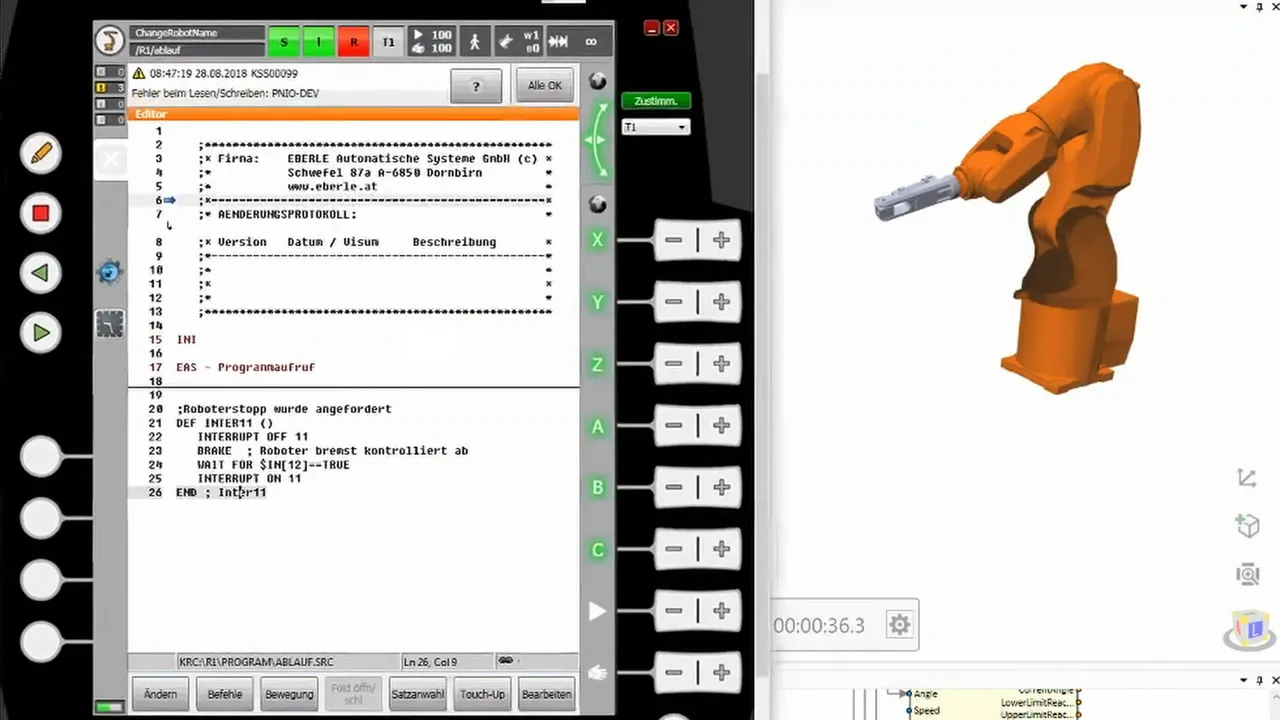
A complete virtual commissioning process requires not only testing the PLC software — the robot programs must also be validated before the real cell exists. With KUKA.OfficeLite, KUKA’s virtual robot controller, and the simulation software twin, this is exactly what becomes possible: the real robot program controls the virtual robot on the digital twin — exactly as it would in reality.
What is KUKA.OfficeLite?
KUKA.OfficeLite is KUKA’s virtual robot control system: software that runs the real KUKA controller (KR C) as a virtual machine on a PC. It behaves like the real controller — including KRL programming, the smartHMI user interface and system software. Programs that run in OfficeLite run unchanged on the real robot too.
This makes OfficeLite the robot counterpart to the virtual PLC (such as SIEMENS S7-PLCSIM Advanced): the control software is not replicated or emulated — the original controller runs virtually — the foundation for meaningful tests.
OfficeLite + twin: the robot works before it exists
Via an interface integrated into twin, KUKA.OfficeLite controls the virtual robot in the digital twin. The process matches reality exactly:
- Load the robot program: the real KRL program runs in KUKA.OfficeLite — without modification.
- Connect the twin: twin couples the virtual controller with the physics-based robot model in the simulated cell.
- Test as on the real plant: motion sequences, gripping processes, signal exchange with the PLC, cycle times and collision scenarios are checked on the digital twin — safely and repeatable as often as needed.
Because PLC simulation and the virtual robot controller run together against the same twin, the result is a holistic test of the cell: interlocks, sequence logic and the interplay of robot, conveyor technology and safety technology are validated before the mechanics are even built.
The video shows how KUKA.OfficeLite controls the virtual robot in twin:
Why it pays off
- Real programs, no re-creation: what was tested on the twin runs on the real plant without translation losses — on-site commissioning is shortened significantly.
- Collisions cost nothing: a crash in the model is a learning moment, not damage. Edge cases can be provoked deliberately.
- Cycle times proven early: already in the engineering phase — or even during the quotation phase — the twin shows whether the cell achieves the required performance.
- Parallelisation: robot programming and mechanical manufacturing run simultaneously instead of one after another.
Already using KUKA.OfficeLite to test your robot programs and want to take the step toward holistic virtual commissioning? That’s exactly what twin was built for — try it for free.