

The status quo — and how we improve it
Many mechanical engineering firms still present concepts with pencil sketches and estimate cycle times in Excel. That has clear drawbacks:
- Function is hard to convey without visible motion.
- Cycle times rely on rules of thumb with large uncertainties.
- Design flaws such as collisions cannot be spotted in a sketch.
digifai has been developing solutions for safe and efficient machine development for over 20 years. The twin software replaces sketches with digital twins — with minimal effort, it delivers insight into function, throughput and bottlenecks.
The eye-opener: why the effort pays off
twin uses physics-based 3D simulation: workpiece motion emerges on its own instead of being laboriously defined. Configuration effort stays minimal, while behaviour stays close to reality.
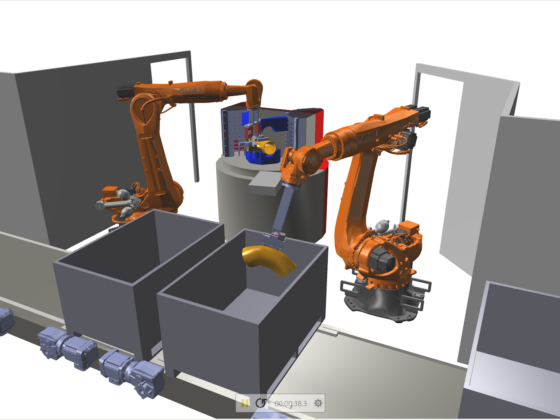
Project example: A customer commissioned a cycle-time estimate for a robotic solution. Within a few hours, a working model was built and used to test various parameters. The result: the original concept was not feasible. The solution lay in an adjusted robot arrangement and a switch to a dual-gripper system — the optimised concept worked.
a few hours — to reach a working cycle-time model — and with it a robust, validated basis for the quotation.
The outcome: significantly reduced quotation risk through realistic validation, minimal effort, a more professional customer presentation — and the order was won.
What does this mean for you?
The digital twin takes the uncertainty out of the quotation: instead of a risky estimate, you present validated figures and win the customer over with a visible, working system. Find out more about how the digital twin performs in sales.