

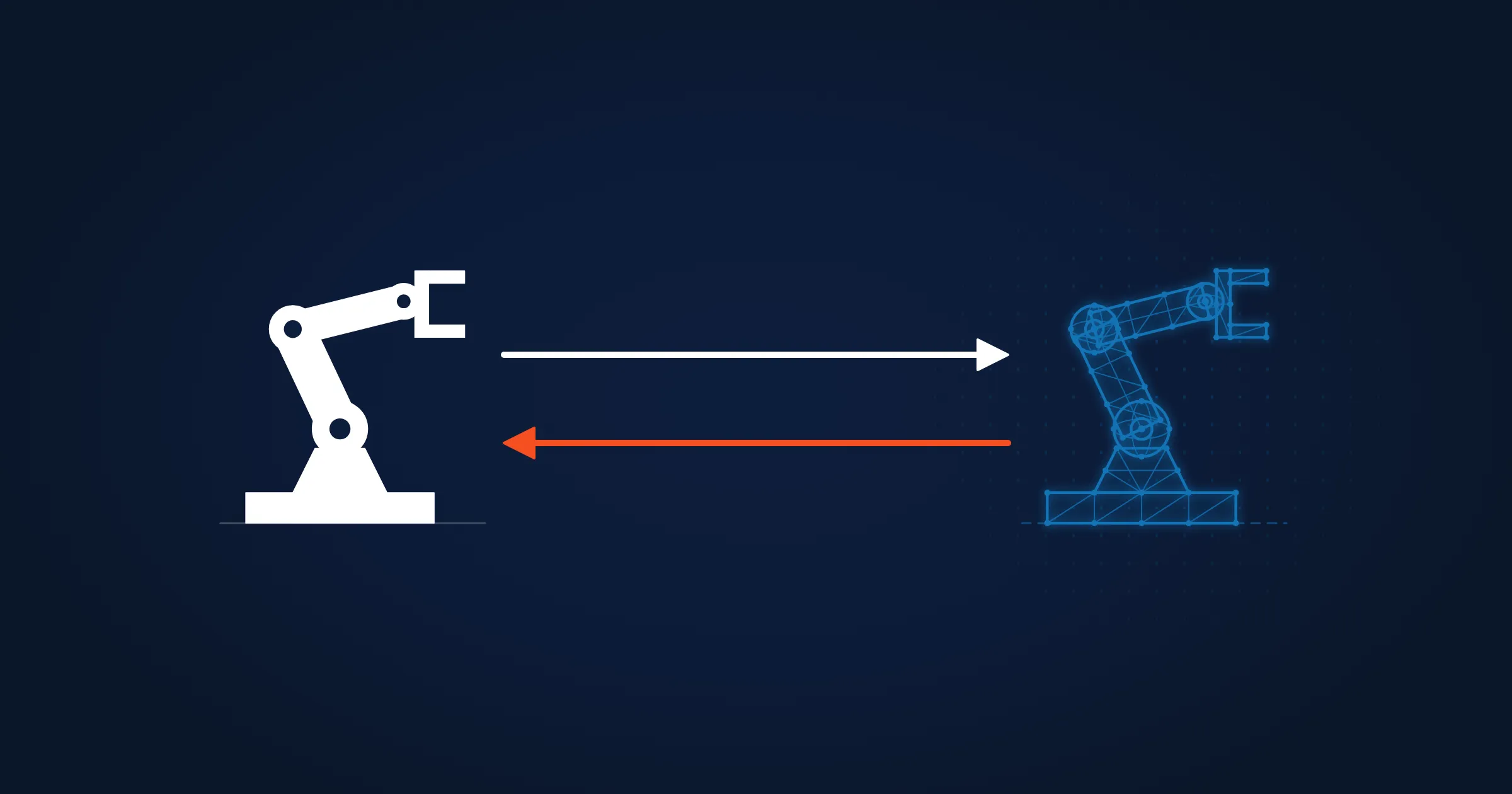
A digital twin is a virtual representation of a specific physical object, system or process that is linked to its real-world counterpart by automated data exchange in both directions: changes in the state of the real object are automatically transferred to the representation, and results from the representation automatically act back on the real object. If data flows automatically only from the real object to the representation, it is called a digital shadow; if there is no automated data exchange at all, it is a digital model (Kritzinger et al., 2018).
The term is used in very different ways in industry, research and marketing, and the scientific literature offers no uniform definition (Negri et al., 2017; Kritzinger et al., 2018). This article summarises what a digital twin is according to the current state of research, where the term comes from, how it differs from related concepts and which standards address it.
Key takeaways
- Definition: According to Kritzinger et al. (2018), a digital twin is a digital representation of an existing physical object that exchanges data with it automatically and in both directions. Broader definitions also include representations of products before they are manufactured (Grieves & Vickers, 2017).
- Distinction: According to Kritzinger et al. (2018), the digital model, digital shadow and digital twin differ in whether, and in which direction, data flows automatically.
- Origin: The concept goes back to Michael Grieves, who introduced it in 2002 in the context of product lifecycle management (Grieves & Vickers, 2017; Grieves, 2019); Grieves attributes the name “Digital Twin” to John Vickers (NASA).
- Components: Grieves describes three basic elements (real space, virtual space, and the data and information link; Grieves, 2014); Tao et al. (2018) extend this into a five-dimension model.
- Standards: For manufacturing, there is the ISO 23247 series (since 2021, currently six parts); for the standardised description of assets, there is the Asset Administration Shell according to IEC 63278-1 (2023).
What is a digital twin? The definition
Several definitions of differing scope have become established in the scientific literature. What they have in common is that a digital twin is more than a 3D model or a simulation: it is assigned to a specific product or system and linked to it through data. What is disputed is whether this counterpart must already exist. The narrow definitions presuppose that it does. In the broad understanding of Grieves and Vickers (2017), a digital twin can also describe a product before it has been manufactured.
The distinction most frequently used in production research comes from Kritzinger et al. (2018). According to it, a digital twin exists only when the data flows between an existing physical object and its digital counterpart are fully automated in both directions; the digital object can then also act as the controlling instance of the physical object.
The definition by Glaessgen and Stargel (2012, p. 7) for NASA and the U.S. Air Force comes from aerospace. They describe the digital twin as an “integrated multiphysics, multiscale, probabilistic simulation of an as-built vehicle or system that uses the best available physical models, sensor updates, fleet history, etc., to mirror the life of its corresponding flying twin”.
Three characteristics follow from the narrow definitions of Kritzinger et al. (2018) and Glaessgen and Stargel (2012); Grieves (2019) emphasises a fourth:
- Real counterpart: The twin refers to a specific, built unit (“as-built”), not merely to a type or design. Grieves and Vickers (2017) take a broader view of the term and also include the Digital Twin Prototype, which describes a product before it is manufactured (see lifecycle).
- Automated data exchange: Data flows from the real object to the representation and back without manual intervention (Kritzinger et al., 2018).
- Lifecycle coverage: The twin accompanies the real object throughout its life and reflects its state and history, “to mirror the life of its corresponding flying twin” (Glaessgen & Stargel, 2012).
- Use-case focus: The type, granularity and scope of the information in the twin depend on the use cases (Grieves, 2019).
Where does the term “digital twin” come from?
The concept goes back to Michael Grieves, who introduced it in 2002 in the context of product lifecycle management (PLM): first in October 2002 in a talk at a management forum of the Society of Manufacturing Engineers (SME), and then in December 2002 in a presentation to industry representatives at the University of Michigan, intended to establish a centre for PLM. The slide from the Michigan presentation was titled “Conceptual Ideal for PLM” and already contained all the elements of the later digital twin: a real space, a virtual space, a data flow from the real to the virtual space, an information flow back, and virtual subspaces (Grieves & Vickers, 2017, p. 93).
In Grieves’ teaching and publications, the model was initially called the “Mirrored Spaces Model” (from 2003) and later the “Information Mirroring Model” (Grieves & Vickers, 2017, p. 93). By his own account, Grieves adopted the name “Digital Twin” from his co-author John Vickers (NASA), who had described the model that way; in Grieves’ book Virtually Perfect (2011), the term was attached to the concept (Grieves & Vickers, 2017, pp. 93–94). At around the same time, the term appears in NASA’s technology roadmap for materials, structures and manufacturing (Piascik et al., 2010).
The term gained broad attention through aerospace, among other things through the paper by Glaessgen and Stargel (2012). In the 2010s, research transferred the concept to manufacturing in the wake of Industry 4.0 and cyber-physical production systems; Negri et al. (2017) trace this development from aerospace to its interpretations in smart manufacturing. Today, the term is also used for energy systems, buildings, infrastructure and medicine.
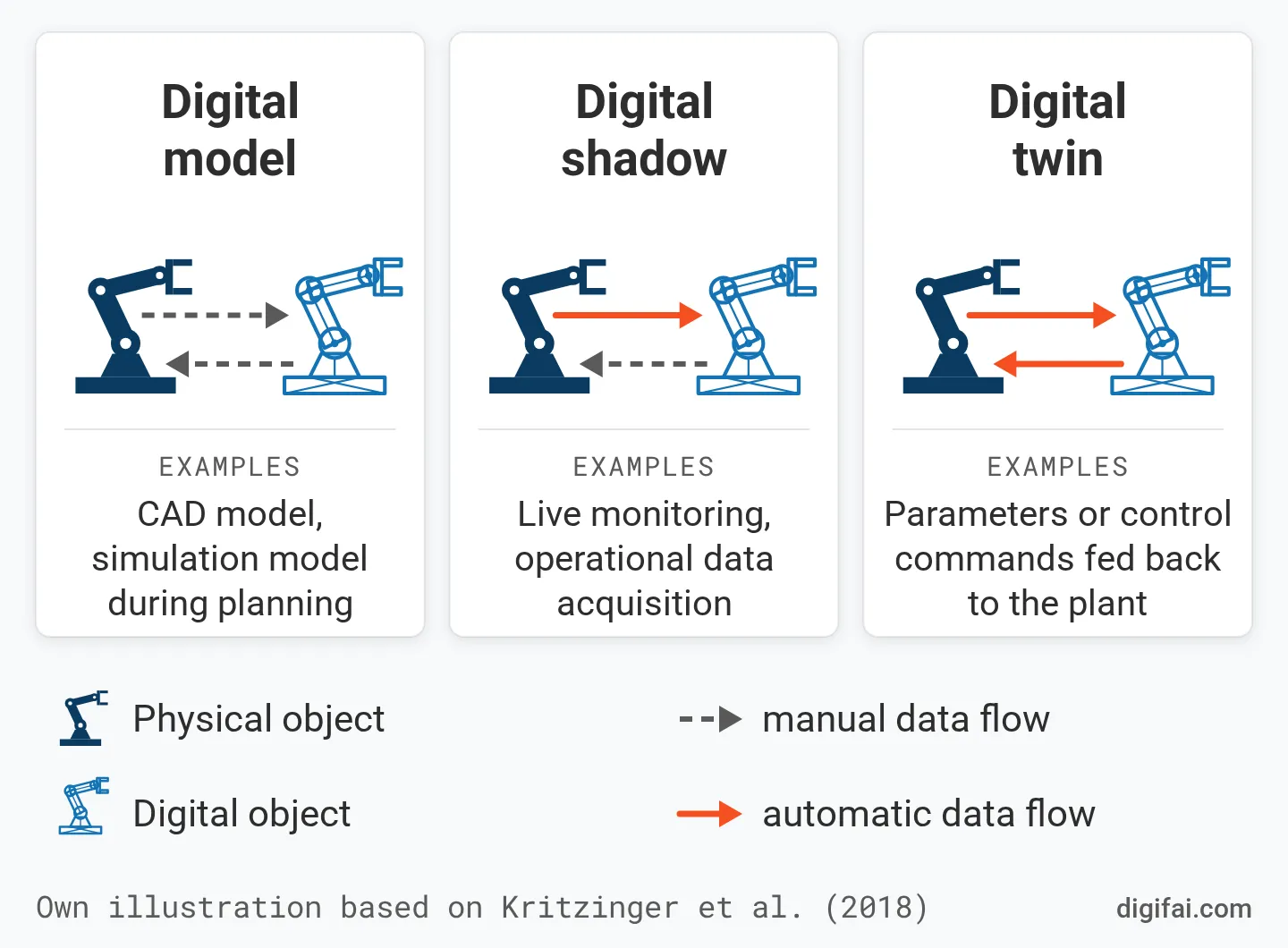
Digital model, digital shadow, digital twin: the three levels according to Kritzinger et al.
The distinction frequently cited today comes from the literature review “Digital Twin in manufacturing: A categorical literature review and classification” by Kritzinger, Karner, Traar, Henjes and Sihn (2018). The authors classify publications according to how far the physical object and its digital representation are integrated in terms of data, and distinguish three levels.
Digital model
A digital model is a digital representation of a planned or existing physical object without any automated data exchange with it. Examples include CAD designs, simulation models in the planning phase or models of an object that does not exist yet. Changes in the state of the real object do not automatically affect the model, and vice versa; data, if transferred at all, is transferred manually.
Digital shadow
In a digital shadow, data flows automatically in one direction: from the state of an existing physical object to the digital representation. A change in the state of the real object leads to a change in the digital representation, but not the other way round. Typical examples are live monitoring, operational data acquisition and condition monitoring. Interventions in the real system are still made by people.
Digital twin
Kritzinger et al. speak of a digital twin only when the data flow is automated in both directions. Changes to the physical object alter the digital representation, and changes or decisions in the digital representation automatically act back on the physical object, for example as a control command or an adjusted process parameter. In their literature review, the authors find that publications on this highest level are rare, whereas there is considerably more literature on digital models and digital shadows (Kritzinger et al., 2018).
Two interpretations of the digital shadow
Besides the definition based on data flow, a second interpretation is widespread, particularly in German-speaking countries. In the production research of RWTH Aachen University, especially in the Cluster of Excellence “Internet of Production”, the digital shadow is a purpose-specific extract of the available data: unlike the digital twin, it comprises only the subset of data needed for a specific task or question, and this data is combined and aggregated for the task at hand (Schuh et al., 2020). Jarke et al. (2018) argue that a well-designed collection of digital shadows in production is more promising than an all-encompassing digital twin. Bauernhansl et al. (2018) likewise understand the digital shadow of production primarily as a concept of information supply: it is meant to ensure a functioning flow of information between all actors inside and outside a factory.
The two interpretations do not contradict each other: one describes the direction of the data flow, the other the purpose and scope of the data. Anyone using the term should state which interpretation is meant.
What does a digital twin consist of?
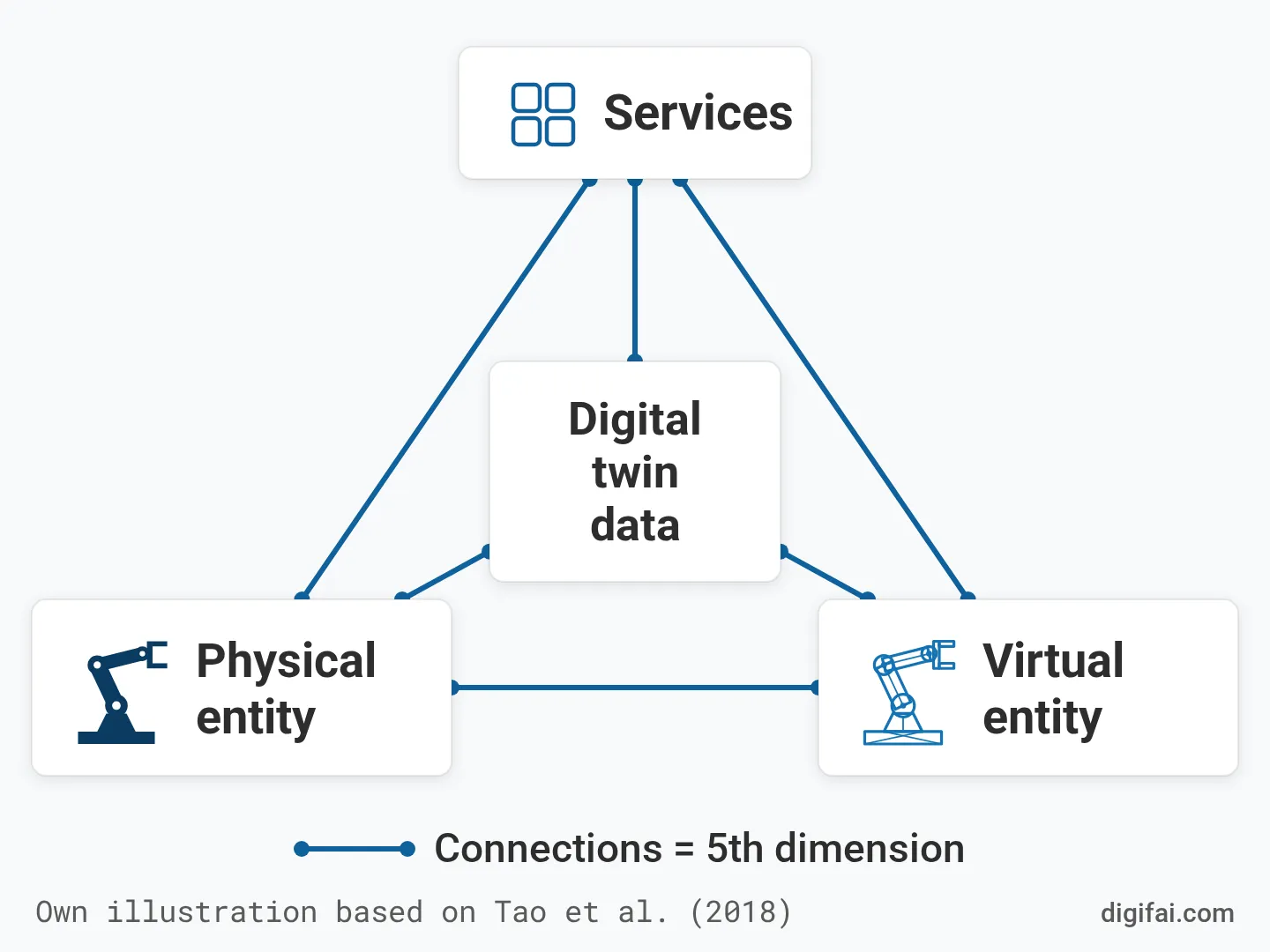
Grieves describes the basic model of the digital twin with three elements: physical products in real space, virtual products in virtual space, and the data and information connections that link the two (Grieves, 2014). In the more detailed account by Grieves and Vickers (2017, p. 93), the connections are separated by direction, and virtual subspaces are added (see origin). Tao and colleagues extended the model with data and services into a five-dimension model (Tao, Zhang, Liu & Nee, 2018):
- Physical entity: the real object, machine or process.
- Virtual entity: the digital models of the object, such as geometric, physical, behavioural and rule-based models.
- Services: functions provided by the twin, such as monitoring, simulation, diagnosis or optimisation.
- Digital twin data: data from the physical and the virtual world, and their fusion.
- Connections: the data exchange between all of the elements above.
The connections link the other four dimensions with one another in pairs, six connections in total, and themselves form the fifth dimension (Tao et al., 2018).
Tao, Zhang, Liu and Nee (2019) provide an overview of the state of research, key components and industrial applications of digital twins, for example in product development, production, and condition monitoring and maintenance.
Digital twins across the lifecycle: prototype, instance, aggregate
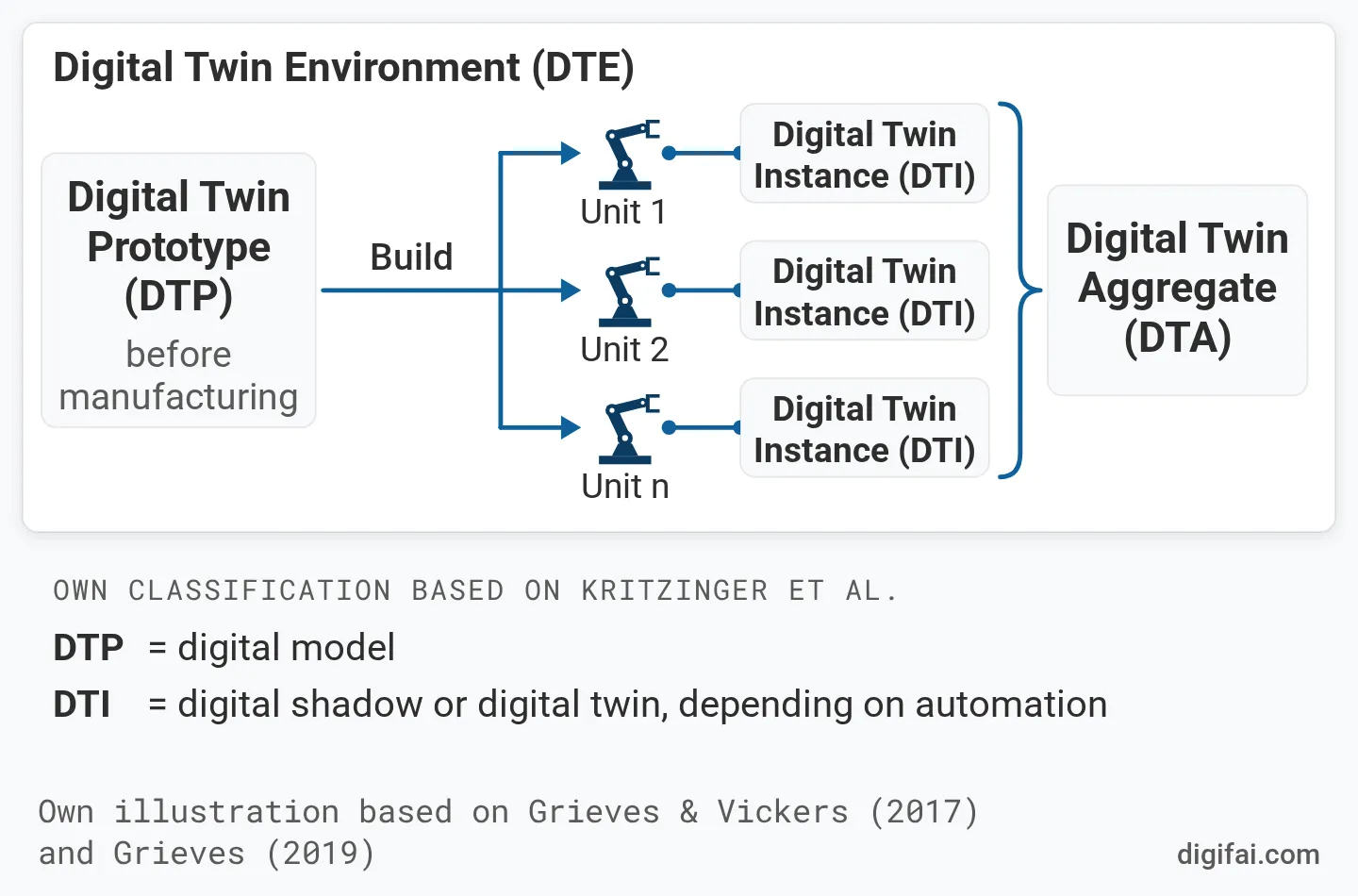
Grieves and Vickers (2017, p. 94) distinguish two types of digital twin, which operate in a shared simulation and analysis environment (Digital Twin Environment):
- Digital Twin Prototype (DTP): describes a product as a prototype before it physically exists, with all the information needed to produce a physical unit, such as requirements, 3D model, bill of materials and process plans.
- Digital Twin Instance (DTI): describes a specific, built unit and remains linked to it throughout its entire life, for example with as-built geometry, installed components, test results, service history and operating states from sensor data.
In later work, Grieves adds a third type (Grieves, 2019):
- Digital Twin Aggregate (DTA): combines the instances of many units, for example to identify patterns across the fleet or to predict failures.
This classification complements the levels of Kritzinger et al.: by their criteria, a Digital Twin Prototype is a digital model, because there is not yet a physical counterpart with which data could be exchanged automatically. Only a Digital Twin Instance can become a digital shadow or a digital twin, depending on how far the data flow is automated.
Digital twin standards
Standardisation is increasingly taking up the concept:
- ISO 23247, titled “Automation systems and integration – Digital twin framework for manufacturing”, describes a framework for digital twins in manufacturing. Parts 1 to 4 (2021) cover the overview and general principles (Part 1), reference architecture (Part 2), digital representation of manufacturing elements (Part 3) and information exchange (Part 4). In 2026, the digital thread for digital twin (Part 5) and digital twin composition (Part 6) were added. The standard understands the digital twin as a fit-for-purpose digital representation of an observable manufacturing element — such as a machine, material, process or product — that is synchronised with it.
- ISO/IEC 30173:2023 (“Digital twin – Concepts and terminology”) establishes cross-industry terms and concepts relating to the digital twin, including system context, lifecycle, types and stakeholders.
- Asset Administration Shell (AAS, German: Verwaltungsschale): In the German Plattform Industrie 4.0 initiative, the Asset Administration Shell is the central concept for making digital representations of assets standardised and interchangeable across manufacturers. Its structure is standardised internationally in IEC 63278-1:2023 (“Asset Administration Shell for industrial applications – Part 1: Asset Administration Shell structure”).
Where are digital twins used?
Digital twins, in the strict as well as the broader sense, are used today in areas including:
- Manufacturing and mechanical engineering: virtual commissioning, process optimisation, condition monitoring and predictive maintenance.
- Aerospace: monitoring of structures and engines over their service life.
- Energy and building technology: optimisation of plants, grids and control strategies.
- Cities and infrastructure: planning of transport, construction projects and climate adaptation.
- Medicine: models of organs or patients for diagnosis and treatment planning, so far mainly in research.
An example from mechanical engineering shows the levels in practice: the simulation model of a packaging machine, used during the design phase to check sequences and cycle times, is a digital model. If, after delivery, axis positions, states and fault messages of the built machine are automatically transferred to the model, a digital shadow is created. A digital twin in the sense of Kritzinger et al. exists when results from the model, such as optimised parameters, are automatically fed back to the controller of the real machine.
Common misconceptions
“A 3D model is a digital twin.” A CAD or 3D model without an automatic connection to the real object is a digital model, however detailed it may be.
“A live dashboard is a digital twin.” A dashboard that displays data from the plant but does not automatically act back on it is, according to Kritzinger et al. (2018), a digital shadow.
“A digital twin has to represent everything.” What information a digital twin contains, and at what level of detail, depends on the use cases (Grieves, 2019). A complete and comprehensively functional digital twin is considered hardly feasible in production, because a large variety of heterogeneous data would have to be processed under constant consistency checks. Production research therefore relies on digital shadows that capture only the data needed for a specific task (Schuh et al., 2020).
“A digital twin and a simulation are the same thing.” A simulation is a method; a digital twin is a representation of a specific object. A digital twin often uses simulation models, but differs from them in its ongoing data connection to its real counterpart.
“Digital twins only pay off for large corporations.” Many applications start with a digital model or digital shadow and are expanded step by step. The levels according to Kritzinger et al. thus also describe a possible development path.
Digital twin — frequently asked questions
References
- Bauernhansl, T.; Hartleif, S.; Felix, T. (2018): The Digital Shadow of production – A concept for the effective and efficient information supply in dynamic industrial environments. Procedia CIRP, 72, 69–74. doi:10.1016/j.procir.2018.03.188
- Glaessgen, E. H.; Stargel, D. S. (2012): The Digital Twin Paradigm for Future NASA and U.S. Air Force Vehicles. 53rd AIAA/ASME/ASCE/AHS/ASC Structures, Structural Dynamics and Materials Conference, Honolulu, AIAA Paper 2012-1818. doi:10.2514/6.2012-1818, freely available via the NASA Technical Reports Server
- Grieves, M. (2011): Virtually Perfect: Driving Innovative and Lean Products through Product Lifecycle Management. Cocoa Beach, FL: Space Coast Press.
- Grieves, M. (2014): Digital Twin: Manufacturing Excellence through Virtual Factory Replication. White paper. Michael W. Grieves, LLC.
- Grieves, M. (2019): Virtually Intelligent Product Systems: Digital and Physical Twins. In: Complex Systems Engineering: Theory and Practice (Progress in Astronautics and Aeronautics, Vol. 256). Reston, VA: AIAA, 175–200. doi:10.2514/5.9781624105654.0175.0200
- Grieves, M.; Vickers, J. (2017): Digital Twin: Mitigating Unpredictable, Undesirable Emergent Behavior in Complex Systems. In: Kahlen, F.-J.; Flumerfelt, S.; Alves, A. (Eds.): Transdisciplinary Perspectives on Complex Systems. Cham: Springer, 85–113. doi:10.1007/978-3-319-38756-7_4
- IEC 63278-1:2023: Asset Administration Shell for industrial applications – Part 1: Asset Administration Shell structure. Geneva: IEC.
- ISO 23247-1 to -4:2021 and ISO 23247-5/-6:2026: Automation systems and integration – Digital twin framework for manufacturing. Part 1: Overview and general principles; Part 2: Reference architecture; Part 3: Digital representation of manufacturing elements; Part 4: Information exchange; Part 5: Digital thread for digital twin; Part 6: Digital twin composition. Geneva: ISO.
- ISO/IEC 30173:2023: Digital twin – Concepts and terminology. Geneva: ISO/IEC.
- Jarke, M.; Schuh, G.; Brecher, C.; Brockmann, M.; Prote, J.-P. (2018): Digital Shadows in the Internet of Production. ERCIM News, 115. Online
- Kritzinger, W.; Karner, M.; Traar, G.; Henjes, J.; Sihn, W. (2018): Digital Twin in manufacturing: A categorical literature review and classification. IFAC-PapersOnLine, 51(11), 1016–1022. doi:10.1016/j.ifacol.2018.08.474
- Negri, E.; Fumagalli, L.; Macchi, M. (2017): A Review of the Roles of Digital Twin in CPS-based Production Systems. Procedia Manufacturing, 11, 939–948. doi:10.1016/j.promfg.2017.07.198
- Piascik, R.; Vickers, J.; Lowry, D.; Scotti, S.; Stewart, J.; Calomino, A. (2010): Technology Area 12: Materials, Structures, Mechanical Systems, and Manufacturing Road Map. Washington, DC: NASA Office of the Chief Technologist.
- Schuh, G.; Häfner, C.; Hopmann, C.; Rumpe, B.; Brockmann, M.; Wortmann, A.; Maibaum, J.; Dalibor, M.; Bibow, P.; Sapel, P.; Kröger, M. (2020): Effizientere Produktion mit Digitalen Schatten [More efficient production with digital shadows]. ZWF Zeitschrift für wirtschaftlichen Fabrikbetrieb, 115 (Special), 105–107. doi:10.3139/104.112339
- Tao, F.; Zhang, M.; Liu, Y.; Nee, A. Y. C. (2018): Digital twin driven prognostics and health management for complex equipment. CIRP Annals, 67(1), 169–172. doi:10.1016/j.cirp.2018.04.055
- Tao, F.; Zhang, H.; Liu, A.; Nee, A. Y. C. (2019): Digital Twin in Industry: State-of-the-Art. IEEE Transactions on Industrial Informatics, 15(4), 2405–2415. doi:10.1109/TII.2018.2873186