

The Factory Acceptance Test — or FAT for short, also known as the works acceptance test — is a fixed part of the engineering process in mechanical and plant engineering. Yet the classical factory acceptance test quickly runs into limits in practice: space, time, material. This article explains how the FAT works, where it reaches its limits — and how digitalising the Factory Acceptance Test with the digital twin removes those limits.
What is a Factory Acceptance Test?
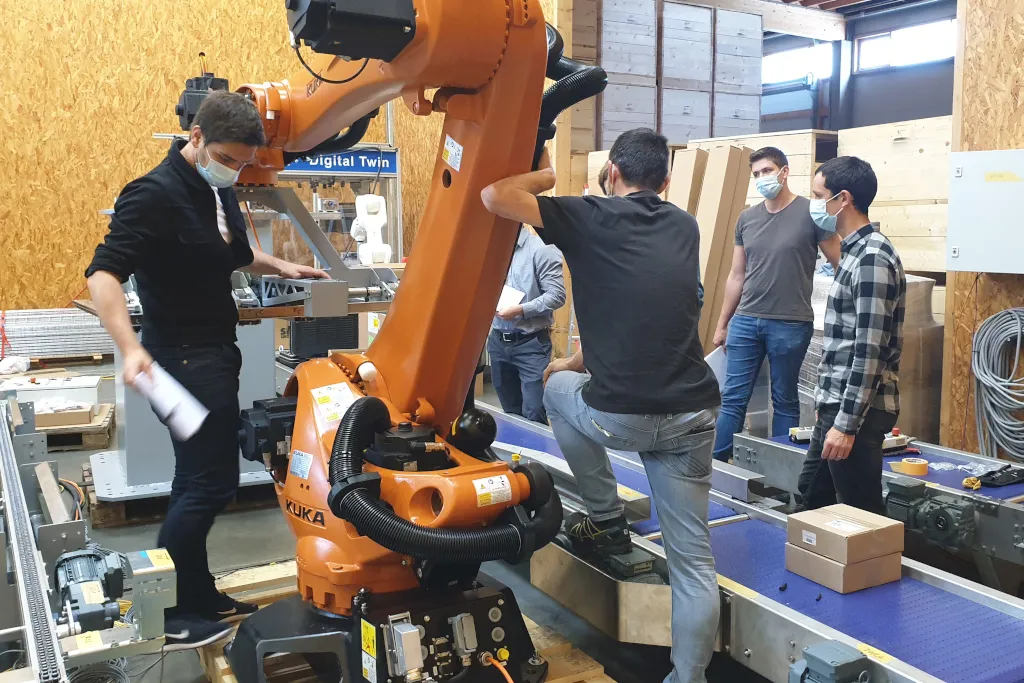
In a Factory Acceptance Test, the machine builder assembles the machine in its own works and commissions the control-related components. Before the machine is shipped, the customer comes to the works: in a joint session, the machine’s functionality is inspected and formally accepted. Requested changes are documented and implemented by the machine builder. Only then is the machine delivered, assembled at the customer’s site — and on-site commissioning begins.
The FAT is therefore an important milestone for both sides: the customer confirms that the machine meets the agreed functionality; the manufacturer receives sign-off for delivery. After installation at the customer’s site, its counterpart follows: the Site Acceptance Test (SAT), the acceptance test at the installation site.
The limits of the classical factory acceptance test
As important as this milestone is — in practice, the entire functionality of a machine can almost never be tested during the factory acceptance test:
- Space: Setting up a large conveyor system in full in the manufacturer’s works is often simply impossible for reasons of space.
- Material: If the machine processes heavy or expensive components, handling them during the FAT involves enormous effort.
- Risk: Edge cases such as faults, emergency-stop scenarios or operator access can only be played through on the real machine to a limited extent and with great caution.
In reality, the FAT therefore usually only inspects individual partial functions. The functionality of the complete machine only becomes apparent after commissioning at the end customer’s site — and subsequent changes or fixes there cost efficiency, quality and money.
The virtual FAT: acceptance testing on the digital twin
This is exactly where digitalising the Factory Acceptance Test comes in. The digital twin is the working 3D counterpart of the real machine: engineers have already developed and tested the control software, robot programs, control system and HMI on the twin during virtual commissioning — as if the real machine were standing on the desk.
This means the entire functionality of the machine exists digitally before the mechanics are built. And this is exactly the complete functionality the customer wants to see at the FAT. Often difficult to achieve in reality — no problem digitally.
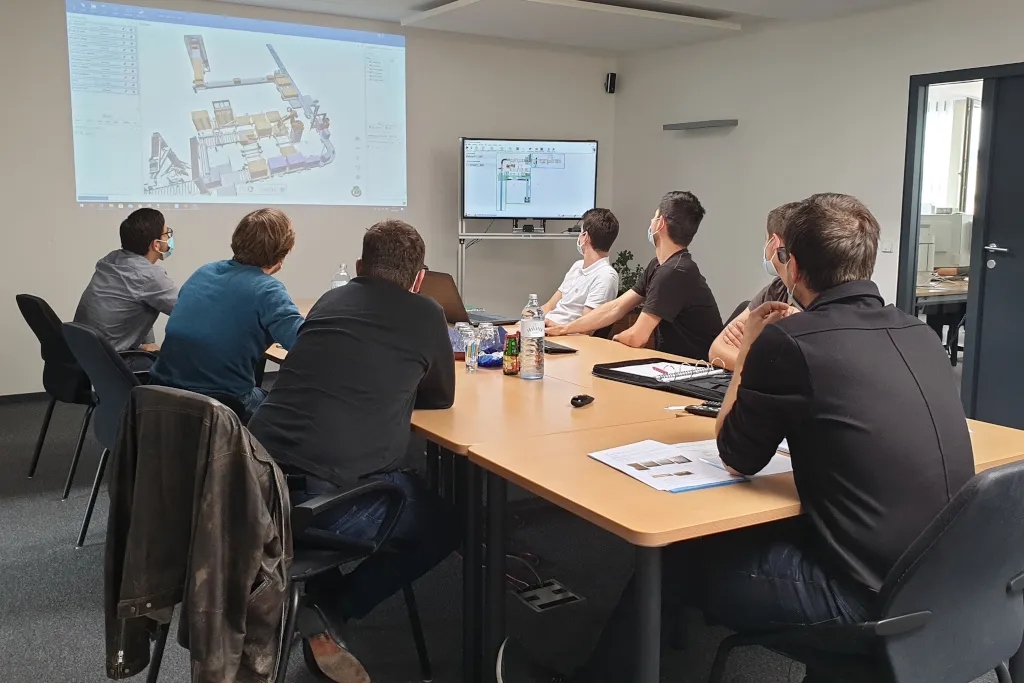
At the virtual Factory Acceptance Test, the manufacturer and customer sit down together. The digital machine behaves like the real one: it is controlled by the real control system and operated via the real SCADA system or HMI. The customer inspects the machine in a safe, virtual environment:
- No space problems — even the largest plant fits on the screen or the projector canvas.
- No damage, no material costs — products can be generated and manipulated at will.
- All scenarios testable — demonstrate cycle times, trigger faults, run through operator access, catch up on production backlogs: all without risk.
- HMI and usability included — because the real SCADA system operates the digital machine, usability is accepted along with it.
- Changes early, not late — change requests from the virtual FAT can be scheduled in before expensive mechanics have to be built or modified.
In our projects, we have used the virtual FAT to work through situations together with customers that would never have been possible at a real factory acceptance test — from demonstrating cycle times to behaviour after faults.
Prerequisite: a digital twin that behaves like the machine
A virtual FAT is only as meaningful as the model it is based on. The simulation software twin generates a physics-based digital twin from CAD data, controlled by the real control system (PLC, robot controller, SCADA) — the same basis that already convinces during the quotation phase in sales and continues working after delivery as a 3D HMI in operation.