

Quite some time ago, the company Eberle Automatische Systeme raised a pointed question: can the real behaviour of a cobot — a collaborative robot — be simulated?
A master’s thesis titled “Simulation of Collaborative Robotics” grew out of that question and got to the bottom of it.
But what does that actually mean?
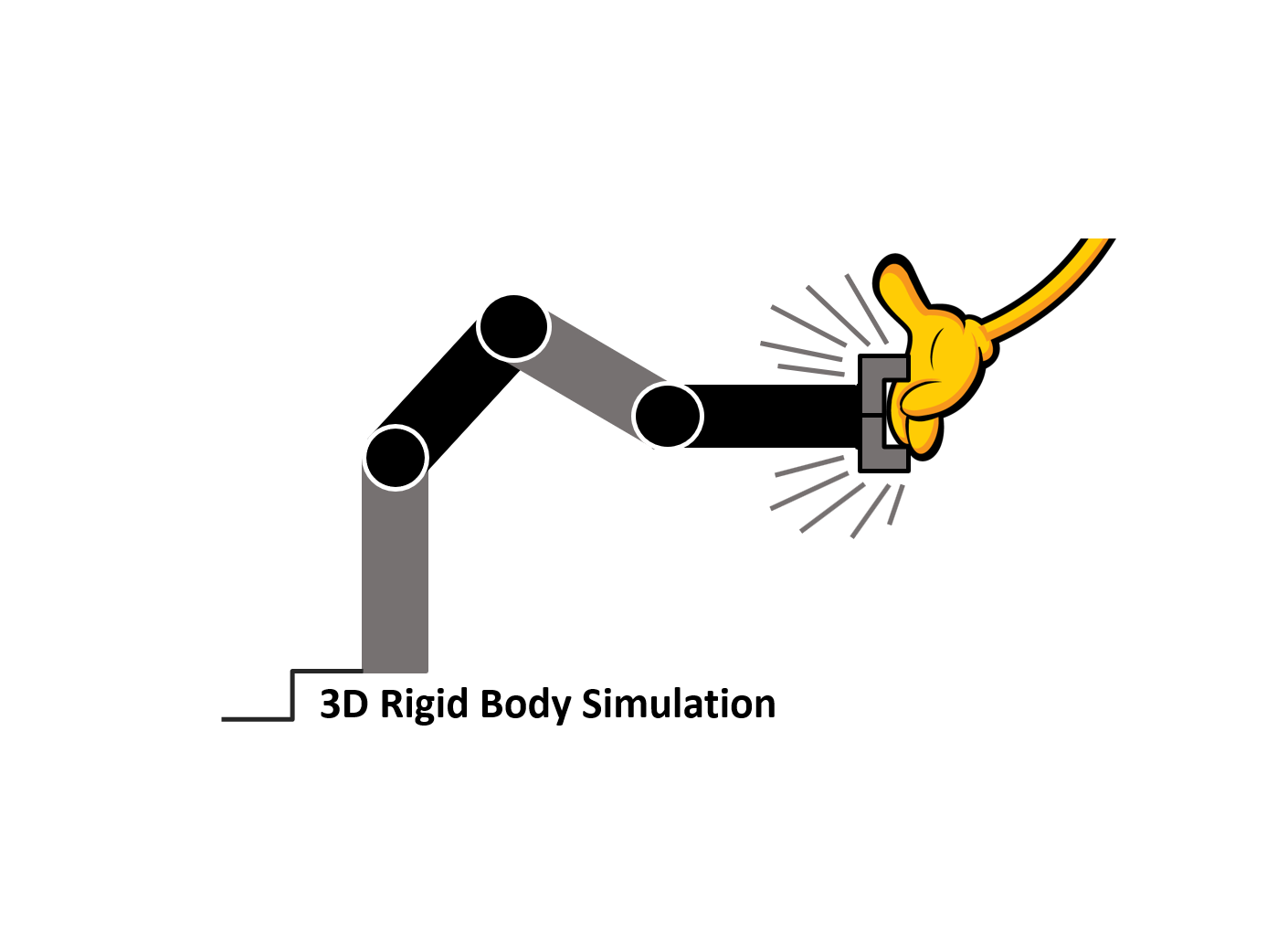
Well, in the real world the robot collides with an object, for example, and its path changes because of that collision. Or a collaborative robot deliberately moves against an object up to a certain disturbance torque and then carries out the next work step. In practice, this has worked quite reliably so far — but can requirements like these be simulated as well?
The complete simulation of cobots — realistic simulation combined with the reaction to unforeseen or deliberate collisions with the environment — has to date not been achieved by any robot manufacturer.
The result of this master’s thesis shows how robots can be simulated realistically and react dynamically to collisions. It is implemented in combination with virtual commissioning on the digital twin, using the simulation software twin.
The investigations showed that the Robot Controller Simulation Module (RCS module for short), a virtual robot controller for realistic simulation, is the best fit in combination with virtual commissioning.
How can this be achieved?
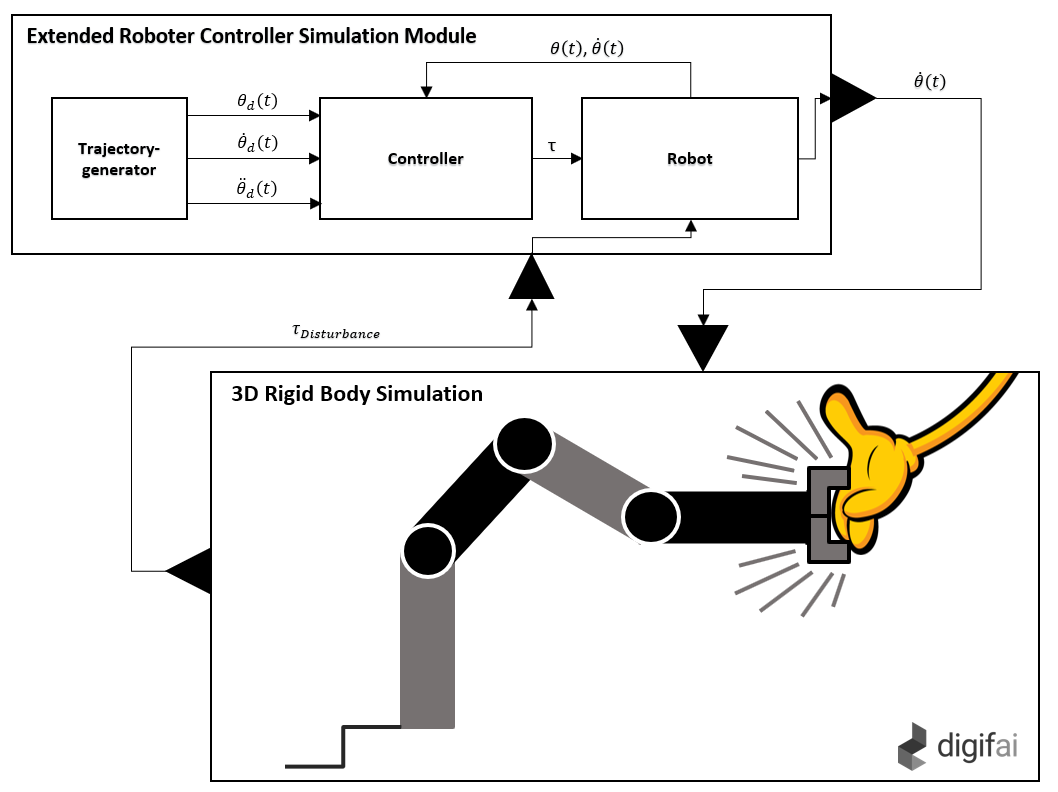
To make dynamic collisions and robot interactions simulable, a method was developed to calculate the disturbance variables occurring during a collision by means of a rigid-body simulation. The resulting dynamic behaviour of the robot during the collision is computed in the controller from the feedback of those disturbance variables (as illustrated in the diagram).
In order to take the fed-back disturbance forces and torques into account, the generally valid dynamic fundamental equations according to Newton-Euler were extended. That extension feeds into the mathematical description of the robot model.
For verification, a simplified prototype of an RCS module was built. With it, a robot can be controlled in the twin simulation environment and react dynamically to collisions and interactions.
The core and the key to this work was the interplay of robot controller, rigid-body simulation and multiphysics simulation using “OpenModelica”.