


Blood is the fuel of our lives. Ideally we have enough of it in our own bodies. There are cases, however, where we lose blood or need fresh blood. In accidents, during operations or after blood loss of any other kind, we depend on blood donations. Doctors then fall back on blood units held in what are known as blood banks. Storing blood outside the body requires know-how, technology and strict monitoring of the relevant parameters. The storage temperature and the temperature of the blood medium itself, for example, are very important parameters.
Blood units need optimal conditions
Blood units are stored in refrigerators, cold cells or cold rooms. These are equipped with local refrigeration controllers that meter out the necessary cooling capacity and monitor the setpoints with temperature sensors. Several temperature sensors are installed in a refrigeration unit for this purpose. The access door is monitored as well, so that an imminent rise in temperature caused by warm outside air entering, for example, can be detected quickly.
Monitoring in the blood bank
At the blood bank of the Austrian Red Cross Vorarlberg, located in the Feldkirch state hospital, the blood units are stored in several separate cold cells. With refrigeration controllers distributed across the site, the challenge is to keep an overview and to be able to react quickly in the event of a fault. One key to this is monitoring from a central point staffed by qualified personnel. Automatic notification and an accessible, easy-to-read visualisation increase both convenience and safety for monitoring. This is where control delivers the right solutions.
Two-stage alerting
The digifai IoT platform control now records all values from the individual refrigeration controllers centrally in a database and visualises the sensor values in the control browser view. The data can be retrieved at any time from any internet-capable device and is also available on mobile. That increases convenience and responsiveness enormously. In control, the thresholds to be observed are defined for every data value. If a data value trend exceeds a threshold, the specialist staff are alerted immediately via the notification function — by SMS, e-mail or phone call, for example. To increase safety, a further escalation level was built into this application. If trend analysis of the measurement series indicates an imminent threshold violation, an advance alert is issued beforehand.
Monitoring with special functions
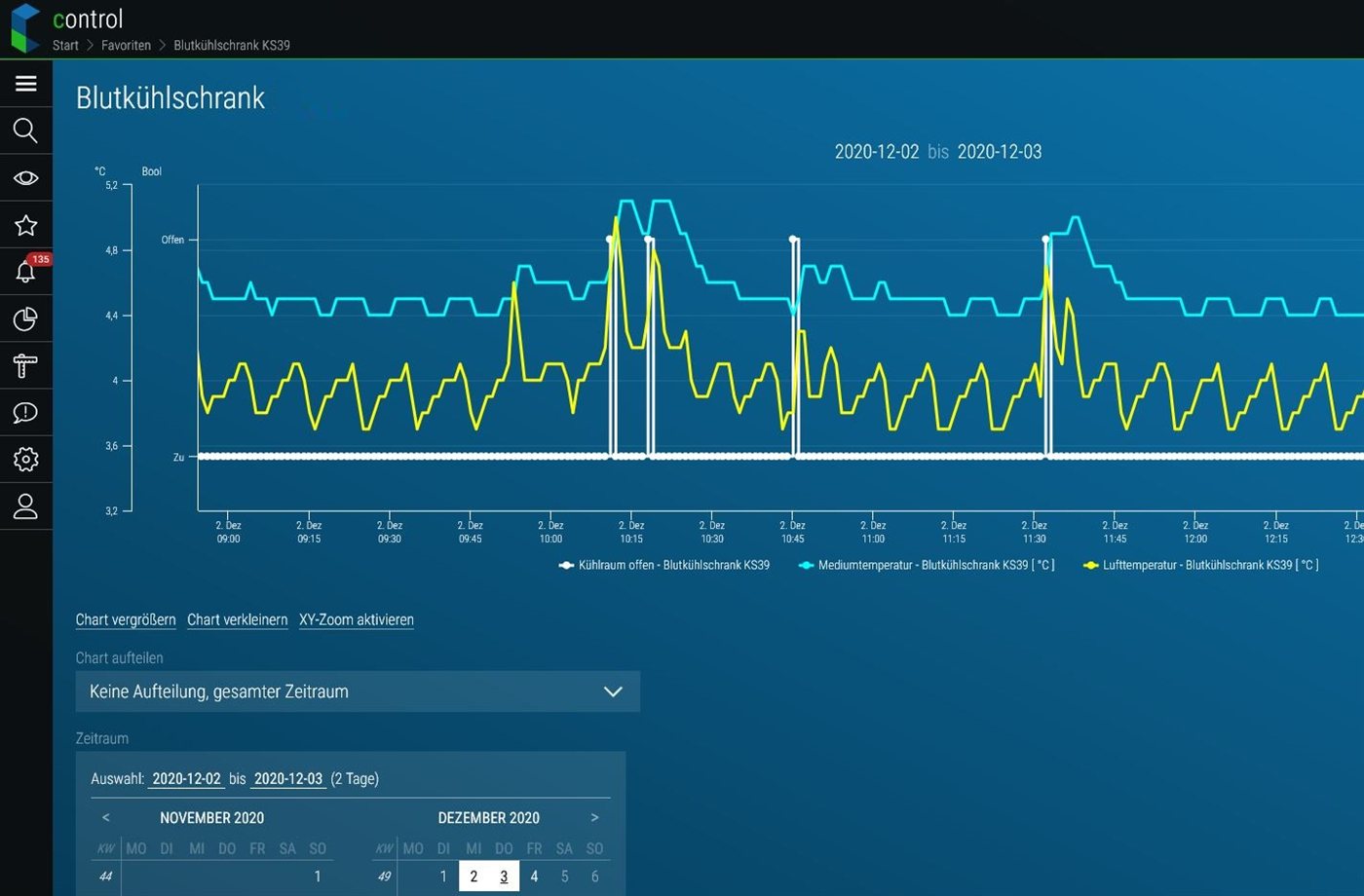
An important function in this application is monitoring the risk of warm outside air entering through doors left open too long. The worst case occurs when someone overlooks closing the door properly at all. control guards against this mishap by monitoring the door contact. If the door stays open too long, an alarm is likewise triggered. The challenge here is that the door contact is a binary signal and therefore does not produce a value history. That means no threshold can be defined — the signal is either 1 or 0. What has to be detected instead is the time elapsed since the signal changed. With the mechanisms available in control, requirements like this are easy to implement too.
Automatic documentation
The temperature data recorded by control not only enables alerting, it also automatically produces the documentation prescribed for medical products. As mentioned above, the storage temperature is an important parameter and one that has to be documented. Proof that the specified thresholds were observed can be provided with the data evaluation in control for every area and for any period of storage. Audits and official inspections can be carried out at the push of a button, and the results printed directly from the browser view.
Easily integrated
The refrigeration controllers were integrated into control via an IoT gateway. In this case, the connection point to the refrigeration controllers is the Modbus RTU interface that was already in place. The IoT gateway continuously reads the individual values from the refrigeration controllers over Modbus RTU and converts them into a network-capable protocol. The gateway itself also buffers the data values as a backup against data loss during network interruptions.
Scalable for further applications as well
Future expansion stages are easy to implement in the application with control. Additional refrigeration controllers simply have to be connected and integrated. The number of users is easy to adjust, and the visualisation can be extended by individual data points or entire data packages as required. Monitoring is not limited to temperatures — it can also cover other laboratory devices and installations.
Customer feedback
The supplier of the cold cells and refrigeration systems, Kiechel & Hagleitner GmbH from Bregenz, was looking for a sound and practical solution to simplify monitoring for its customer.
The requirements for displaying the temperatures and forwarding the alerts became more and more demanding over the course of the project. In control we found the perfect solution for realising this project.