
The Nesensohn small hydropower plant in Laterns
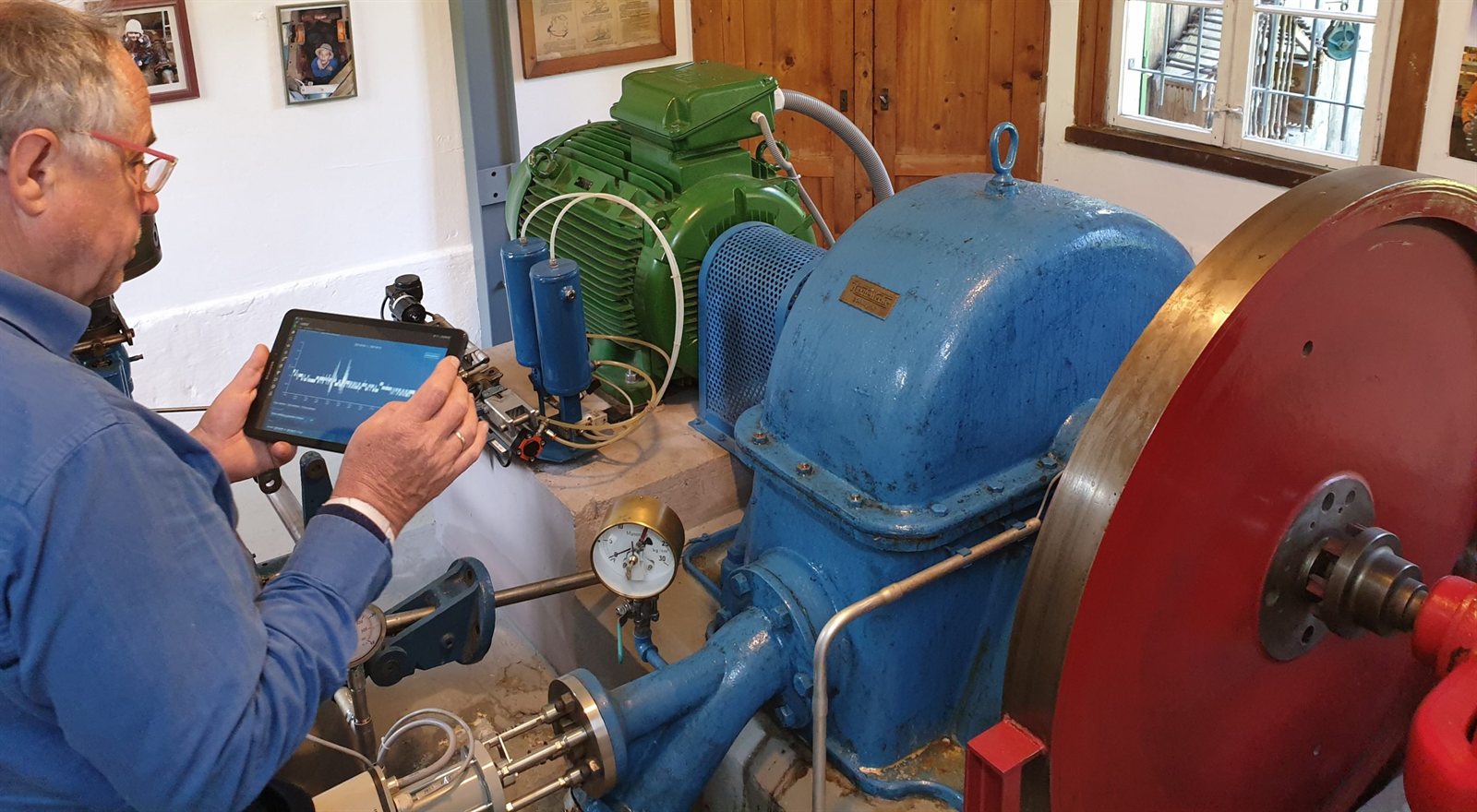
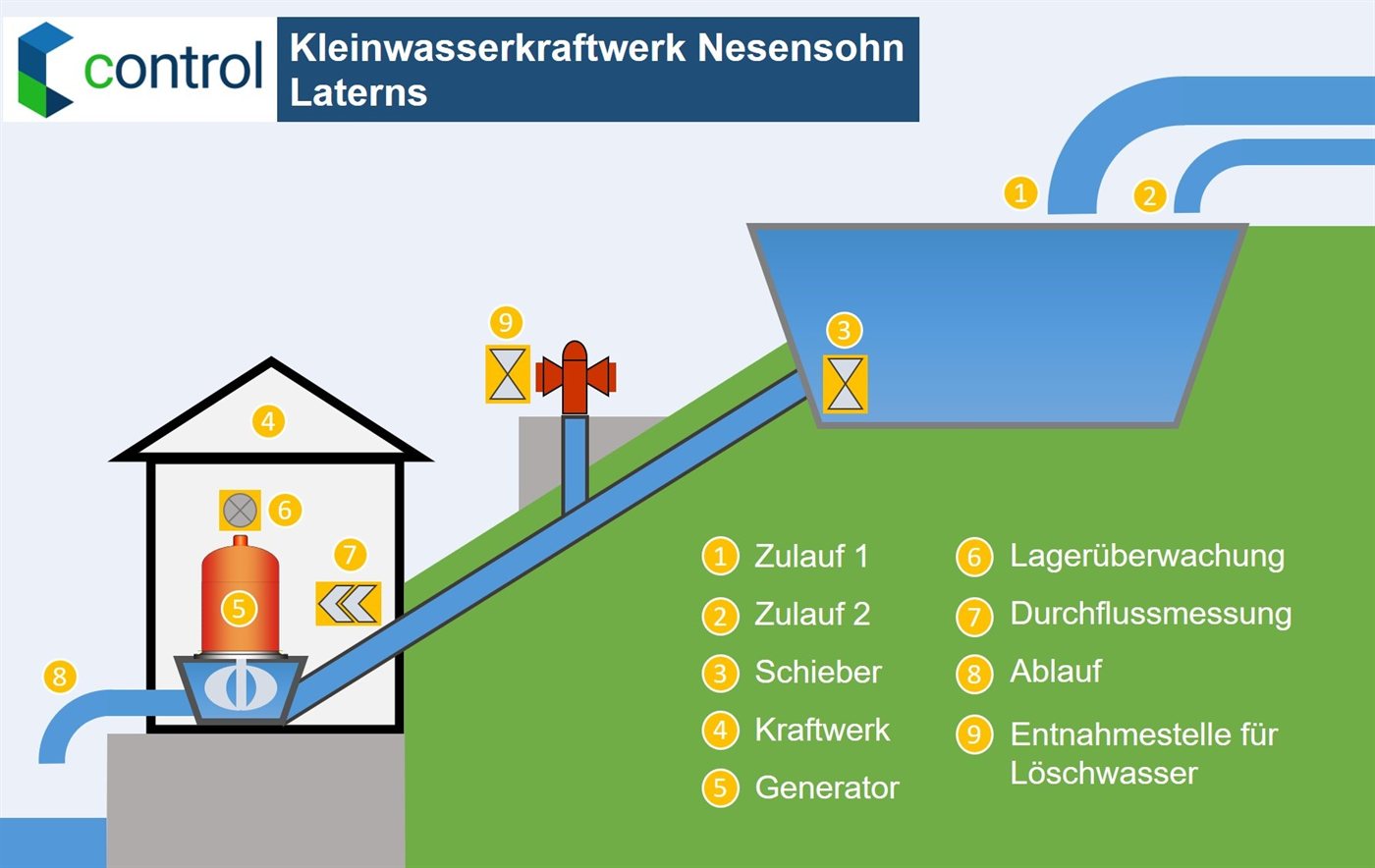
This small hydropower plant was built back in 1922 in the municipality of Laterns in Vorarlberg (Austria). Originally, the plant was the only way to supply the village and the surrounding farms with electricity. Today Mr Nesensohn operates this gem in the middle of the mountains and feeds the electricity it generates into the public grid. The small hydropower plant is fed from a high-level reservoir, which in turn is supplied by two natural inflows. The reservoir sits at around 1,211 m above sea level and the plant itself at around 980 m above sea level. Reservoir and plant are connected by an underground pressure pipeline with a total length of roughly 977 m. The installation has a generator with a rated output of 50 kW, driven CO2-neutrally by water power alone. Small hydropower plants like this are therefore an important building block for the energy transition, for climate protection and for CO2-neutral power generation. Around five years ago the plant was refurbished and its control technology brought up to the latest standard. As part of that update, the plant was also connected to the IoT platform control, which supports the operator in operation and maintenance.
When there is a fire and the fire brigade turns out
In an emergency, when a fire has to be extinguished, the water held in the high-level reservoir is needed to supply firefighting water. An extraction point for firefighting water is available at roughly the halfway mark of the plant’s pressure pipeline. In this situation the plant has to shut down power production in a controlled manner, and the reservoir has to supply the extraction point with sufficient water. The IoT platform supports the plant operator in this emergency with automated alarm messages and location-independent access to the current operating states.
The IoT platform connects the widely distributed plant units
The plant consists of several widely distributed units. The high-level reservoir is around one kilometre away from the power house and is equipped with technical installations such as level measurement, temperature measurement and outflow control via a gate valve. The reservoir is also monitored by a camera. Over a length of roughly 977 m, the pressure pipeline has to be monitored for pipe bursts and any loss of water, so that damage from uncontrolled water escape — flooding or landslides — is avoided. The firefighting water extraction point also has to be monitored: if there is a demand for water here, the plant must be able to react in time. In the power house itself, technical installations such as the generator, the bearing temperature, the flow rates and the operating parameters of power generation itself — voltage, current, frequency, output and so on — have to be monitored. There are cameras in the power house as well, so that the generator set can be viewed remotely. An IoT platform offers the best conditions for linking the individual plant units. The technologies needed for plant monitoring — IoT interfaces for the most diverse data sources, alerting functions, remote connections — are available as standard. Given the widely branched structure, it is a major advantage for the plant operator to be able to access the individual units from a mobile device via the IoT platform.
Mobile monitoring makes supervising the plant easier
Location-independent access to the plant’s current operating states makes supervising it considerably easier. With the IoT platform, all current and historical data as well as alarm and fault messages can be viewed. Wherever the plant operator happens to be, the IoT platform and mobile monitoring give him access to the information he needs. Via the platform he can reach every part of the installation while on the move. He gets an overview of the water resource and power production data and, directly through the IoT platform, the option of looking into the individual plant units remotely via the cameras. If action is required, he can even intervene actively in the process from a mobile device via the IoT platform and operate the plant units remotely.
Virtual data points replace costly measuring equipment
Deriving the necessary information from related data points and representing it as virtual data points — that is what an IoT platform and the analysis tools implemented in it as standard make possible. In this case the technology even replaces costly measuring equipment. Pipe burst monitoring at the Nesensohn plant is based on the volume of water flowing out of the high-level reservoir and the volume arriving at the power house. What makes this installation special is the firefighting water extraction point at roughly the halfway mark. Any extraction of firefighting water naturally has to be taken into account for this kind of monitoring. In the end, though, it is data values which — considered in relation to one another — provide the necessary information as to whether the pipeline is intact. If the parameters do not match, an alarm message is generated immediately. The pipeline is monitored around the clock on the basis of virtually formed data points.
Digital analysis tools for predictive maintenance
IoT platforms can collect data and derive information from it. Analysis tools identify and pinpoint trends and deviations. These functions are particularly important for predictive maintenance. They are in use at the Nesensohn plant as well. One example is bearing monitoring on the water wheel. The bearings are critical components in the installation. A failure would mean a production outage and a costly repair, because the bearing shells are specially manufactured. The IoT platform monitors the bearing temperature, and it monitors the ambient temperature too. If the bearing temperature now rises in a ratio that is untypical for the ambient temperature, the IoT platform generates a fault message and an alert. The plant operator can then investigate the cause in a targeted way and correct the fault in good time, before a total failure occurs. The IoT platform supports the plant operator digitally in plant monitoring and is active around the clock.
Decentralised, IoT-connected energy supplies support the energy transition
Using alternative energy sources — water power in this example, or other alternative forms of generation such as solar energy or plant-based energy carriers — makes an important contribution to the energy transition. The more such local, decentralised energy sources come into being, the more important connectivity and the use of IoT technologies become. Only through connectivity and automated monitoring can decentralised installations in widely branched plant networks be operated economically and to a high standard. IoT platforms make alternative energy sources fit for the future!