
In practice, data formats and the technical maturity of data sources vary widely.
The big challenge for automated operational data acquisition in existing structures often lies in tapping into the many different data sources of machines, plant units or individual sensors in the first place. Installed bases typically contain equipment from different manufacturers with differing digital interfaces — or none at all. In structures that have grown over time, that is entirely normal. On top of that come in-house technical installations where the focus at the moment of installation was on function, and data acquisition did not yet play a role. Beyond this, end-to-end operational data acquisition should also make manually recorded data available, for example data values for assessing quality or measurement results. In practice, the data is simply wherever it arises.
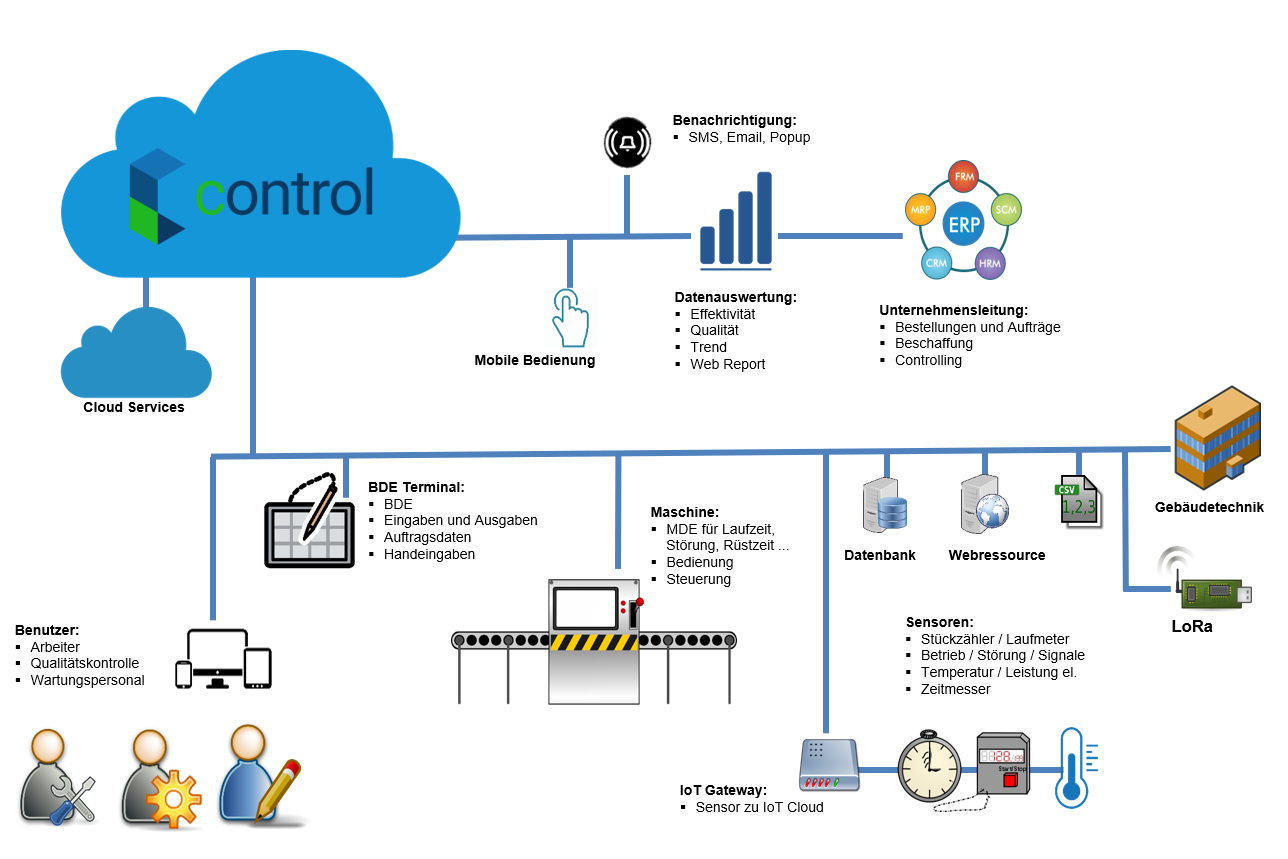
An IoT platform such as control sets out to tap into these data sources and to enable collaborative exchange with higher-level and lower-level systems.
An exchange platform and collaborative data basis for the entire company
That is what every process specialist, every controller and, above all, management wants. Only real and timely key figures allow the current situation to be assessed properly, and they can be an important trigger for future strategic decisions.
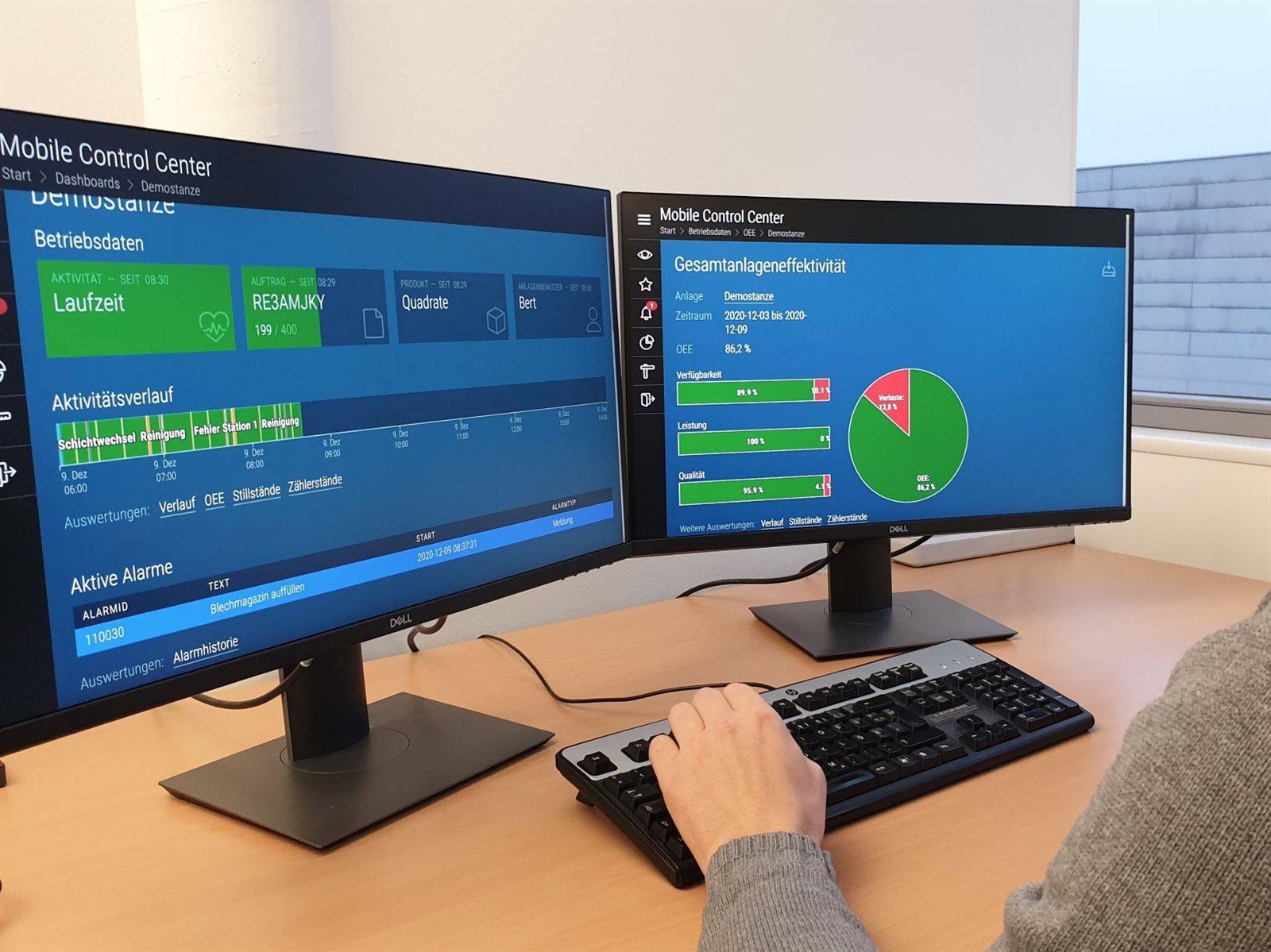
A collaborative data platform such as control makes data and key figures from production accessible in concentrated, prepared form. The information can be shared and distributed far more widely than at the local production control station. Web technology makes it possible to access current production data from any internet-capable device. A fine-grained user management system governs who may view which data. Alongside accessibility, mobile availability is also a major factor. What has long since become established in private life still tends to play a secondary role in industrial applications.
Exchanging data between company management, the ERP system and production management or the machine level can be a major challenge — particularly when the corresponding 1:1 interfaces first have to be created between the individual systems. This is where an IoT platform equipped with a wide range of interfaces as standard can serve successfully as a connective exchange platform. In practice, alongside production data itself, energy, building and consumption data are playing an increasingly important role, and these usually have no standardised industrial interfaces. Here, too, an IoT platform can do a good job of exchanging data.
In production, and especially at machine level, large volumes of data accumulate in short cycle times — consider the signals from a programmable logic controller (PLC) in a production machine. Conversely, that means a flood of data which, over time, also takes up large amounts of storage if every signal is to be recorded. For production operations, however, usually only one piece of information from this flood of data is needed. In such cases, an IoT platform can take over the necessary data pre-processing and automatic information filtering. Almost like an operating system, the IoT platform controls the data processing sequence — an IoT operating system.
IoT platform as a secure, cross-site data interface
Networking individual machines or production lines within a single site can already be a substantial undertaking. So what happens when several sites are to be networked with one another over the internet? For that, it is enormously important to have a secured infrastructure, such as a Virtual Private Network (VPN) connection provides. Only then can the networking of the data sources begin.
The IoT platform control is designed to tap into data sources over the internet and comes with the corresponding interfaces and the required functionality. In the simplest case, an IoT gateway installed directly at the data source and an internet connection are enough. The IoT gateway establishes the secure connection to the IoT platform on the one side and serves as the interface to the data source on the other.
Via the IoT platform, remote sites and their data are conveniently linked through a secured web connection. Web technology also makes it possible to visualise the data on any internet-capable end device, regardless of location.
Integration is remarkably simple and can scale with your requirements
Networking by means of an IoT platform is remarkably simple, because there is no need to build 1:1 interfaces between different systems. The IoT platform control already comes with a wide variety of interface drivers, connectors and hardware solutions such as IoT gateways. In the background, digifai supports customers with experts from the software and hardware fields when integrating data sources. Installation is usually carried out remotely over the internet. All the customer has to arrange is an internet connection to the data source. Experts take care of the rest.
An IoT platform also comes with standardised, easily scalable procedures for integrating data sources. The otherwise lengthy procedure for connecting data sources to a central system is therefore no longer necessary.
Anyone opting for an IoT platform offered as a software as a service model is acting with an eye on the future. The main advantage is that a central data platform can be implemented step by step or area by area. Functions and further expansion stages can be added as required — or scaled back to what is actually needed. An IoT platform makes the end-to-end digitalisation of operational data acquisition considerably easier.
Check your data basis and your data landscape
To find a starting point for implementing a central data basis in your company, the following questions usually arise.
- Which data sources exist? (For example: machines, controllers, sensors or local databases)
- Which interfaces are already in place?
- Which data, key figures and reports are genuinely needed?
- Where and in which parts of the company is this data needed?
- Are the locations of the data sources served by an internet connection, or is there a way to cover those areas with radio and mobile networks?
With expert support from the digifai team, the prerequisites and options for implementation can be checked quickly. Simply ask us, or try our online demo to get started with the topic.