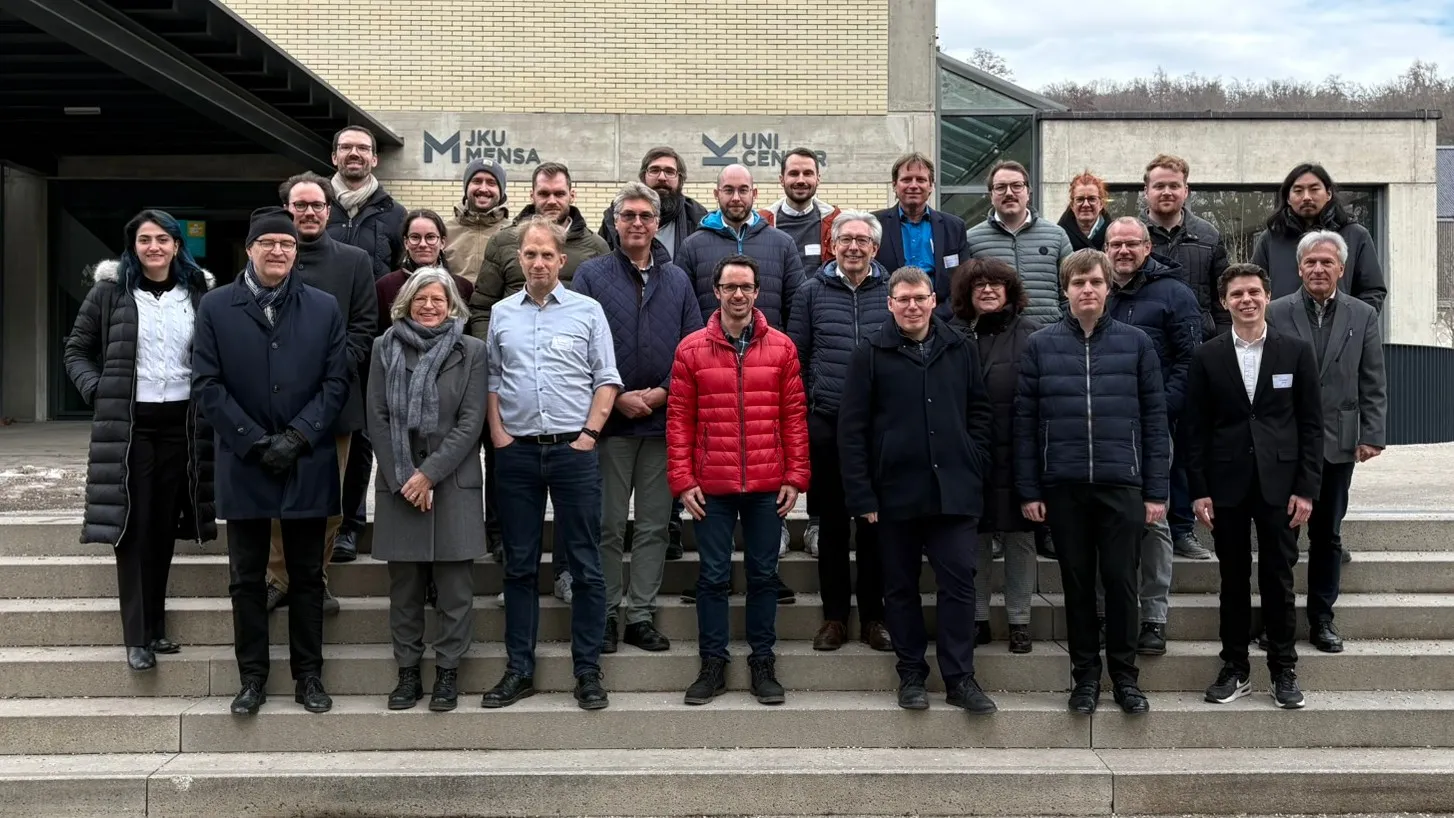

An industrial metaverse is a shared virtual space in which several companies work on the same plant without giving away their know-how. That is exactly what digifai is researching in the MetaLin-X project: together with 13 other partners, funded by the FFG and led by Eberle Automatische Systeme GmbH & Co KG — the company digifai emerged from.
The need comes straight from project practice. A special-purpose machine is never built single-handedly: end customer, supplier and machine builder each contribute their knowledge — process know-how, component models, plant concepts. Every party wants, and has, to protect its intellectual property. And yet the collaboration is supposed to run seamlessly.
The problem: planning together without giving away know-how
Anyone who designs a plant across company boundaries today knows the trade-off: either models and data are shared generously — and know-how leaks out. Or everyone keeps their data to themselves — and joint planning rests on drawings, datasheets and assumptions. Errors only surface during commissioning, where they are most expensive.
What is missing is a shared virtual workspace: a place where the digital twins of all parties come together and are simulated and evaluated jointly — without anyone having to disclose their intellectual property.
What an industrial metaverse in machine building has to deliver
The term is often confused with the consumer metaverse, but has little to do with it. It is not about avatars and virtual worlds to hang out in, but about industrial value creation: an industrial metaverse is a physics-based virtual space that reproduces real machines, production lines and processes true to scale and is coupled to them via live data.
For machine building, this translates into three requirements:
- Multi-user across company boundaries — several parties work on the same model at the same time, not one after another on copies of it
- Real-time capable — real machine data and control signals flow directly into the environment instead of being imported after the fact
- Legally sound — who may see which data is governed technically and contractually, not just by verbal agreement
The third point is the hardest. It is also the reason why MetaLin-X does not develop the industrial metaverse in isolation, but together with a sovereign data space.
What MetaLin-X is building
MetaLin-X — “Secure digital collaboration for the industry of tomorrow” — creates a continuous virtual working and simulation environment for the entire product lifecycle. It combines four building blocks:
- Digital twins as realistic replicas of machines, robots and plants
- Sovereign data spaces, in which the data owner controls who may see what
- Asset Administration Shells (AAS) as a standardized description of assets and interfaces
- An industrial metaverse as a shared, interactive 3D workspace
The technological backbone is a gigabit-capable infrastructure with high bandwidth, low latency and high availability — without it, data exchange on this scale would not be possible at all. The whole approach is demonstrated along the injection molding value chain: from co-design and co-simulation through virtual commissioning to ongoing operations monitoring.
The four work packages
1. Digital twin framework
Heterogeneous data sources — real-time machine data, simulation data, CAD and kinematic models — are merged in a structured way and made usable for metaverse applications. At its core is a modular approach that automatically aggregates the digital twins of individual components and subsystems into a consistent overall system. Planned interfaces and formats include MQTT, OPC UA PubSub, DDS, HDF5, FMI/FMU and VTK.
2. Gigabit-capable data space
Conventional data spaces are designed for transaction-oriented file exchange. MetaLin-X extends them so that dynamic, time-critical data streams also run reliably. The focus shifts from exchanging individual files to accessing interfaces: validation and contract processes are handled once at the start and decoupled from the ongoing data stream. Standards such as Verifiable Credentials, ODRL and AAS secure this technically and contractually — sensitive, IP-relevant data can be specifically excluded from transmission.
3. Industrial metaverse
This is where the actual working environment takes shape: an immersive 3D world in which users move freely, interact with objects and processes, and collaborate across sites and companies. Real machine data is integrated and processed directly; the connection to the data space ensures that communication runs over a trustworthy infrastructure.
4. Pilot operation and evaluation
The integrative work package merges all components into an overall system and proves their practical suitability under real conditions. This includes selecting the target platform, cloud integration with automated deployment of digital twins, a hybrid network infrastructure of fiber optics and 5G campus networks, and a scientific user study that directly compares conventional and metaverse-supported commissioning.
digifai’s contribution
The role as consortium lead stems from a rare combination: machine building and simulation under one roof. For more than 25 years, Eberle Automatische Systeme has delivered turnkey solutions in special-purpose machine building — from concept through mechanical and electrical design, PLC and robot programming to commissioning at the customer’s site. Alongside this, the simulation software twin for machines and robots is developed under the digifai brand.
Specifically, the contribution includes:
- Know-how from special-purpose machine building — the requirements come from daily project practice, not from the drawing board
- Software and expertise in simulation and digital twins — twin as a proven basis for physics-based models that connect to real controllers
- Implementation of individual modules in the areas of metaverse and data exchange
- Participation in the pilot operation phase, where it becomes clear what holds up under real conditions
What machine builders gain
Research projects have a reputation for being far removed from the shop floor. MetaLin-X deliberately targets effects that show up in project budgets:
- Shorter development and commissioning times, because concepts are validated earlier and jointly
- Fewer queries and iterations between end customer, supplier and machine builder
- Protected know-how — collaboration is no longer held back by the fear of knowledge drain
- New options in operation for maintenance, reconfiguration, software testing and remote operation
Getting there is not a leap but a continuation: anyone who already simulates feasibility and concepts or anticipates commissioning virtually today is already working with exactly the models that are meant to come together in the industrial metaverse.
Consortium and funding
MetaLin-X runs for two years, from 2026 to 2028, with a funding volume of around EUR 1.9 million. The project is funded by the Austrian Research Promotion Agency (FFG) with resources from the Federal Ministry of Innovation, Mobility and Infrastructure (BMIMI).
The consortium brings together 14 partners from industry and research: Eberle Automatische Systeme, Plastic Innovation, Brinkhaus, Siemens, Posedio, IMW, IFT, MIVP, ACOmarket, Haidlmair, Simpatec, the TU Wien Pilot Factory Industry 4.0, JKU Linz and TU Graz. More information about the project is available from AMIDS.