
In modern special-purpose machine building, project success is no longer decided by experience and gut feeling alone. Amid rising complexity in the age of Industry 4.0, reducing risk has become the top priority. Every plant is unique, every process a new challenge. The answer to the question of certainty lies in the digital twin.
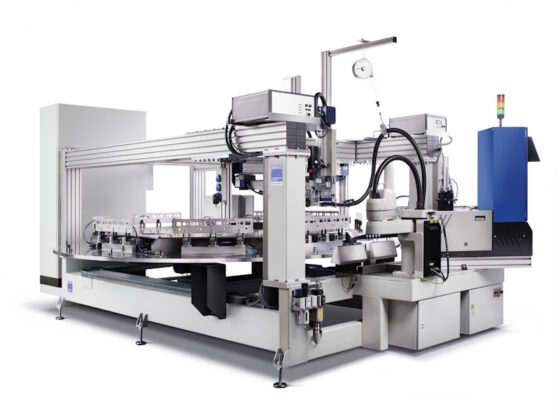
A company already living this new reality is the Vorarlberg-based automation specialist Eberle Automatische Systeme GmbH & Co KG. In demanding special-purpose machine building, Eberle relies on simulation with twin to ensure maximum planning certainty from the first idea through to final commissioning – for itself and for its customers.
What is a feasibility study in mechanical engineering?
A feasibility study clarifies, before a project begins, whether a plant concept is technically and economically viable — for example the choice of robots, the design of conveyor sections and the cycle times that are realistically achievable. Traditionally, these answers rest on experience — with the digital twin, they are replaced by validated data.
Certainty from the outset: redefining the feasibility study
The first step towards a successful plant is a watertight concept. Together with the customer, decisive questions are clarified on the virtual model as early as the sales phase: which robots are optimal? How must conveyor sections be designed? What cycle times are realistic?
This approach replaces vague assumptions with validated data. Martin Moosmann, CEO at Eberle, puts it in a nutshell:
Many people are proud of their experience, but that is no longer enough. We need the certainty of simulated data. It is testable and takes the risk out of the project. In special-purpose machine building, every machine is different – there are hardly any real benchmarks.

With twin, a precise digital twin of the plant is created at an early stage. The customer sees not just a 3D model, but a functional simulation within their future production environment. Does the plant fit into the hall? Does the infrastructure need to be adapted? These questions are answered long before costly mistakes can arise in the real world.
Virtual commissioning: risk-free testing, in parallel with development
The decisive paradigm shift takes place during the development phase. Instead of testing a control program under time pressure on the finished machine at the customer’s site, twin moves this process entirely into the virtual world.
- Collision and cycle-time analysis: Engineers develop and test PLC programs directly on the digital twin. Potential collisions between components and workpieces are identified early, as are bottlenecks in the cycle. The plant concept is perfected step by step.
- Real control feedback: The virtual machine is connected to the real controllers (PLCs). Thanks to identical actuators and sensors in the model, the controller detects no difference from reality. Every sensor, every drive, every emergency stop can be run through under every conceivable scenario. Missing sensors or logic errors become apparent immediately.
- Decoupling software from hardware: While the real machine is being built, software development and testing run in parallel at full speed. This eases the entire development cycle and results in significantly more robust software at delivery.
The result: on-site commissioning is drastically shortened. Instead of weeks of troubleshooting and fine-tuning, only the final polish remains.
Commissioning time at the customer shifts into engineering, which brings enormous cost savings.
More than commissioning: a partner for the entire lifecycle
twin’s strength does not end with delivery. The digital twin remains on the customer’s machine as an intelligent 3D HMI and becomes a valuable investment in the future:
- Efficient operator training: Future operators can be trained on the animated model long before the machine exists. Ergonomic or logical issues in handling are identified and resolved at an early stage.
- Optimised maintenance and troubleshooting: The visualisation enables precise remote support. Instead of describing a fault over the phone, both sides see the same picture, which massively speeds up problem resolution.
- Future-proof retrofitting: Does the plant need to be converted for new products or technologies? Changes are simulated and validated risk-free on the digital twin. Only once everything works perfectly is the real machine rebuilt. This minimises downtime and secures the flexibility that is decisive for Industry 4.0.
Conclusion: foresight as a competitive edge
Simulation with a digital twin is no longer optional — it is a decisive competitive advantage. Software such as twin by digifai turns uncertainty into validated facts, risk into manageable processes and cost traps into efficiency gains. From the first feasibility study through commissioning to retrofitting years later – you gain the confidence to steer even the most complex automation projects safely and successfully to completion.