
Why is operational and machine data acquisition necessary in the first place? Companies, plants, production lines, machines and systems all have one thing in common: generating a positive return from them is only possible if smooth operation with the highest possible utilisation is assured — downtime always costs money, to a greater or lesser degree.
At management level, it is taken for granted — and of course also governed by statutory requirements — that accounting, for example, is mandatory. At production level, in the operational area of many companies, the process is often still steered with a mix of gut feeling, estimates and empirical values. An organisation of that kind requires skilled staff with a great deal of expertise, experience and frequently excessive commitment in order to get sudden process deviations under control. Looked at the other way round, the success of the operation depends on how well and for how long those skilled staff, with their outsized willingness to step in, remain available to the company. Losing them can mean a lockdown of the entire process, or it takes considerable financial effort to reach the desired result again.
Data exchange between the management level and production is just as important. If it happens on the basis of estimates and empirical values, detailed capacity management and cost-oriented planning or costing are difficult to carry out. A solid data basis for operational data is supplied by current actual data from the process; it makes procedures transparent and ultimately creates knowledge — digital production knowledge. And knowledge is capital, which in turn can be deployed more sensibly than in coping with “provoked” outages.
What can be achieved with operational data acquisition?
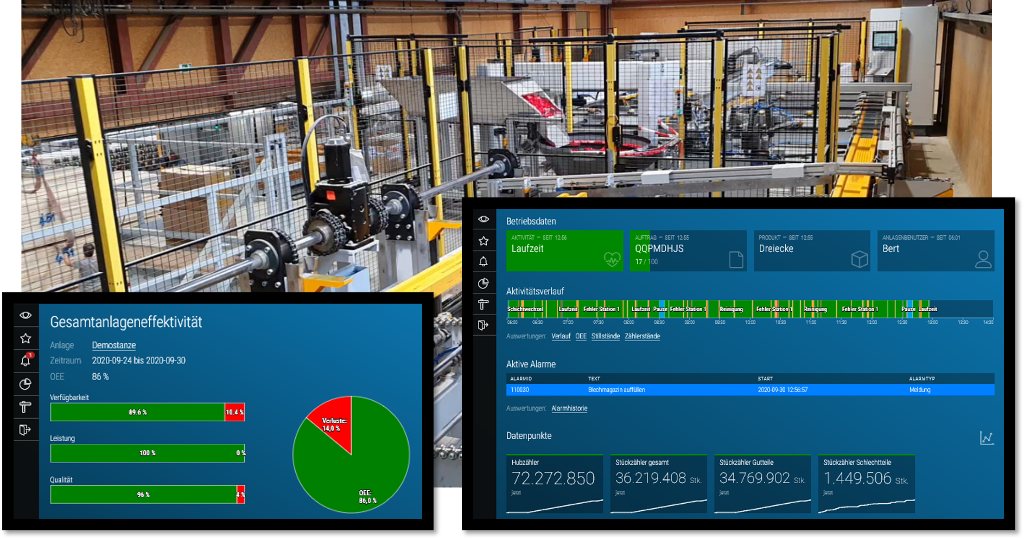
A modern operational data acquisition system automates data capture through suitable interfaces, includes machine data and, as a connective platform, links the management level with the production level. The permanently available data basis, built on real actual data, makes it possible to take decisions in the “now” and provides very good data quality for analyses or forecasts. Where in the process chain can effectiveness or cost efficiency be increased? Operational data acquisition makes the process flow transparent and reveals weak points immediately. Based on the recorded data values, a wide variety of evaluations can be carried out across many different reference dimensions — time scales or sites, for example. Reporting such as shift, daily, weekly or monthly reports with the usual key figures for performance and quality, through to overall equipment effectiveness across process chains, is digital and automated.
As long as everything runs like clockwork, reacting and replanning within the process is not strictly necessary. That changes very quickly when unforeseen events such as machine failures, a lack of work or a major order put the process flow under strain. Decisions then have to be taken quickly and reliably. With digital operational data acquisition, the actual key figures and the capability of production are known precisely. Wherever something now has to be compensated for, targeted countermeasures — deploying staff, for example — can be taken. For the future and for the production of tomorrow, automated operational data acquisition is indispensable. Times are changing: production has to cope with smaller batch sizes, products are becoming more individual and have to be available faster.
Today we already talk about automated sequences of work, also known as workflows, and about interconnected production lines (cyber-physical systems) whose processes are even meant to regulate themselves. Numerous technologies are available for this, such as IoT platforms, digital twins, artificial intelligence and cloud applications. These technologies need data as the basis for their operation. Collaboration between people and machines requires exactly that kind of interworking — including the corresponding interfaces for digital data acquisition.
Where does it make sense to digitise and automate data acquisition?
Every investment and every change to the organisation has to deliver an improvement and a corresponding benefit. Investing in automated operational data acquisition pays off when:
- data recording is required by law or by standards
- business decisions are to be based on actual process data
- planning reliability is to be improved
- operational disruptions can be reduced
- there is a desire to improve production sequences
- the operating supplies and consumables used are to be deployed in a resource-efficient way
- the productivity of machines or staff is to be increased
- production quality is to be improved
- customer satisfaction can be increased
- it makes sense for the company, controlling or quality management for other reasons
These are the usual pointers from practice. The motivation for introducing automated operational data acquisition can vary widely. In principle, the guiding question is where and to what extent collecting data values and gaining information can support the process now or in the future.
How can modern technologies support implementation?
The step from “yes” to operational data acquisition immediately raises the question: “How and with which system should this be implemented?” Modern data acquisition systems such as control follow a web-based approach. The advantages are obvious: the application is available on any internet-capable device without major installation effort.
Data sources such as machines, controllers and sensors can be integrated into the data acquisition system quickly and cost-effectively by means of what are known as IoT gateways, acting as the interface between hardware and software. Manual entries and handwritten records can be made directly in the browser application via online forms. Data source and user management can be handled through an administrative login directly in the application. No special programming skills are required for this.
The entire system is secured on multiple levels, and access takes place over a secured internet connection with a password-protected user login. Processing the data calls for functions that generate information from data value histories. Trend analyses, triggering on limit values with various escalation levels, automated calculation of key figures and the recording of measurement series, for example, are — together with digital reporting — the must-haves in modern operational data acquisition.
To trigger automated notifications and alarms and to start automatic workflows, the data acquisition system should include these capabilities, as control does. Thanks to web technologies, easy and fast integration is assured, because the network infrastructure that is usually already in place — the internet — is combined with cloud functionality.
Digital alone does not yet mean collaboratively available and mobile!
The key to acceptance of automated operational data acquisition is availability and ease of use at all process levels. It therefore makes sense to provide data acquisition on the basis of cloud technology. Besides availability, this solution approach also brings the advantage of mobile process monitoring. The platform for operational data acquisition should be built as an IoT solution, as control is — with the approach of being able to exchange information collaboratively with third-party systems and with staff. Local data silos, by contrast, usually do not deliver the desired effect.
Tips for implementation
The requirements placed on operational data acquisition can vary widely. Equally, everyday practice in the process has to be factored into the choice of system. The first step, however, is to be clear about which data sources, machines, systems and sensors are relevant for data acquisition. What information should be obtained from the process, and via which interfaces will the data be made accessible? It is advisable to build up your own expert knowledge here or to bring it in externally. So that data acquisition projects do not end up stalling because of their assumed complexity, an approach of small steps is recommended. Functionality and practical suitability within your own process can be explored on suitable test or pilot installations. A pilot phase makes it clear which requirements exist for a roll-out and what effort is to be expected.
A practical example — it really is that simple!
The activity of an existing machine is to be recorded. The machine itself has no digital interfaces whatsoever, but it does have an operating and fault indicator. The signal from these indicators is connected to an IoT gateway.
Solution:
- IoT gateway with power supply and LTE modem
- Digital input module
- Auxiliary contacts if required
Once commissioned, the data is captured continuously and manual recording is no longer necessary. The “digital” operating display records the operating hours and the interruptions caused by faults. The machine operator can record online in control why a fault occurred, or which one it was.
Machine data acquisition made easy!