

The challenges in mechanical engineering
Mechanical engineers and automation specialists keep running into three problems: long commissioning times with staff that’s hard to motivate, concept errors that should have been caught earlier, and automation projects that carry too much risk. digifai CTO Michael Eberle sums up the goal: customers should “build the best machines”.
The solution: the simulation software twin
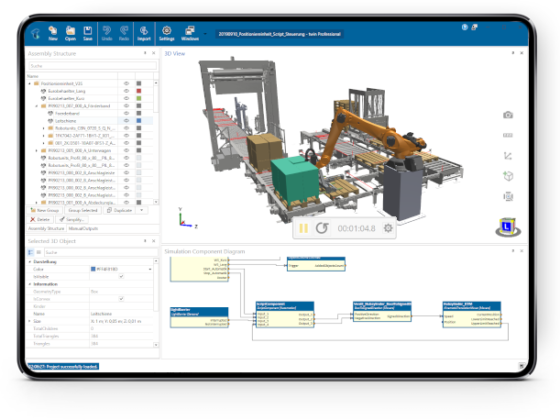
twin turns CAD data into a physics-based digital twin, making it possible to validate machine concepts early in the automation project. This addresses feasibility, cycle times, component selection and risk reduction before any real costs are incurred.
In engineering: test everything before it’s built
In engineering, twin serves as a comprehensive test environment for the control software — the PLC, robots and HMI are all verified before the physical machine exists. Read more on the virtual commissioning page.
In operation: twin Mirror and the control platform
Once the plant is running, twin Mirror provides an interactive 3D visualisation of the machine, integrated into HMI and SCADA systems. The IIoT platform control collects the operating data in parallel and makes it available to the machine operator — the digital twin accompanies the machine across its entire lifecycle.