
In a world where precision and speed decide market success, machine builders face the constant challenge of realising ever more complex systems in ever shorter timeframes. Every planning error in the concept phase costs valuable resources; every delay in commissioning puts the success of the project at risk. K&S Anlagenbau GmbH, a master of highly specialised production lines, has turned this pressure into a strategic advantage. Their tool: the simulation software twin from digifai, which brings the digital twin to life from the first sketch through to running operation.
The Challenge: 5,500 Parts per Minute – Zero Tolerance for Error
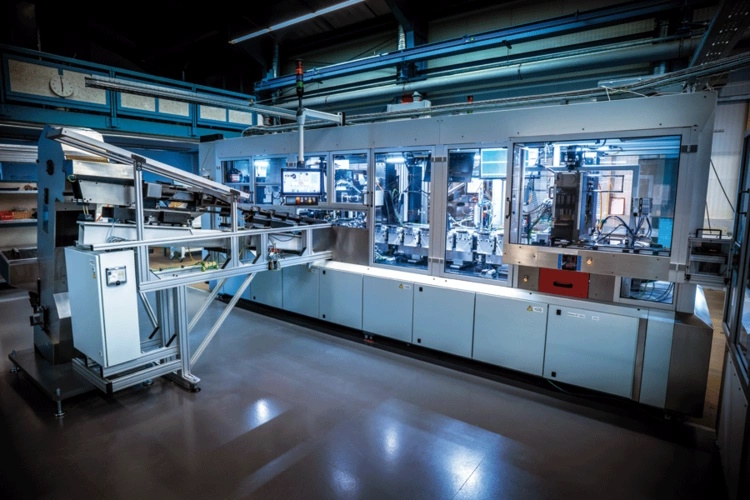
To understand the capability of modern plant engineering, a look at one of K&S’s reference systems says it all: across 32 lanes, 5,500 individual parts are fed in and processed into more than 500 finished components per minute. At this kind of throughput, one thing is clear: classic trial-and-error commissioning is not an option. The risk of collisions, cycle-time conflicts and undetected logic errors would be immense. This is exactly where K&S’s strategy comes in: end-to-end simulation that de-risks the entire development process.
Confidence from the First Idea: the Validated Machine Concept
Before a single component is manufactured, the system already exists in twin. “We already use twin in the concept phase, as well as in domain-specific development work for various departments. Our long-term goal is virtual commissioning, which can likewise be implemented with twin,” says Fabian Böck, Simulation & Software at K&S Anlagenbau GmbH, summing up the integrated approach.
We already use twin in the concept phase, as well as in domain-specific development work for various departments. Even — or especially — here in special-purpose machinery: our long-term goal is virtual commissioning!
A decisive advantage is the ability to draw on a proven library of modules. Existing, optimised assemblies can be imported into new projects as digital modules. This builds a powerful library that dramatically speeds up the design of new systems. Even complex track systems, in which objects move along defined paths, can be simulated and validated with precision. The result: a robust machine concept that has already been thoroughly tested and proven digitally.
A Revolution in Engineering: Real-Time Virtual Commissioning
In the next phase, the digital twin of the complete machine — or at least of a particularly high-risk section — is created from the 3D CAD data. This digital clone is more than just an animation; it has exactly the same actuators and sensors as its real counterpart.
The decisive step for the future: connecting the real controllers (PLCs). For the control systems, there is no difference between the digital twin and the physical machine. Engineers can develop, test and optimise the entire control software while the real machine is still being built.
The benefits of this approach are transformative:
- Parallelisation: software development and hardware manufacturing run in parallel, not sequentially.
- Risk-free testing: every conceivable scenario, every possible cycle-time variant and every imaginable malfunction can be run through safely. Collision checks and the optimisation of motion sequences take place on the model.
- Absolute confidence: the software that is later loaded onto the system has already been tested 100% in the interplay of all its components.
More Than Just Technology: a Strategic Lever for the Whole Company
Virtual commissioning with twin has an impact that reaches far beyond the development department.
- In sales: a sales engineer can show prospective customers not just drawings, but a running, virtual machine. This builds trust, visualises the solution and reduces risk in cycle-time analyses during the quotation phase.
- For retrofits: existing systems have to be adapted flexibly for new products. With twin, these conversions are first planned and simulated on the 3D model. This guarantees that the adapted machine starts up again quickly and smoothly — a decisive factor for flexible production in the spirit of Industry 4.0.
- In operator training: staff can be trained on the animated, interactive model long before the real machine is standing. This uncovers potential usability issues early and ensures a smooth production start.
Summing up, Mr Böck reports on the successful implementation within the company:
When K&S began this development several years ago, the digital twin was a trend. We were surprised ourselves at how quickly and reliably the method could be applied, and how it suddenly caught on from department to department. By now, we even simulate the sorting of individual parts before we build a feeder system.
The Result: Measurable Success and a Future-Proof Investment
Shifting commissioning effort into the digital world of engineering is not an end in itself. It delivers tangible, economic benefits. Stefan Kirchbihler, authorised signatory at K&S Anlagenbau GmbH, sums it up:
Commissioning time shifts into engineering, which brings substantial cost savings. This makes it possible to shorten project lead times by up to 20%.

This efficiency gain, combined with greater process reliability and flexibility across a plant’s entire lifecycle, makes twin an investment in the company’s future viability.
Ready to Accelerate Your Development Processes and Minimise Project Risk?
Get in touch now and discover how the leading simulation software twin can take your machine building to the next level, too. Say goodbye to costly surprises during commissioning and gain the decisive edge over your competition.