 English
 Deutsch

A head start through simulation: The digital twin as a game changer in mechanical engineering
Time pressure during commissioning, costly errors on the actual machine, and the growing need for flexibility — these are the challenges that managers and engineers in modern mechanical engineering face every day. One solution that has evolved from a mere buzzword to a practical technology is the digital twin. igm Robotersysteme AG, a leading manufacturer of welding robots for heavy components, impressively demonstrates how digifai’s twin simulation software not only perfects virtual commissioning but also optimizes the entire life cycle of a system.
The challenge: mastering complexity
igm robot systems are highly complex systems. With 6 to 8 axes, often suspended for maximum use of working space, they weld components weighing from 500 kg to 50 tons — from train components and excavator arms to ship parts.
“The control system for our robots is completely digital. This allows for rapid response times, absolute repeatability, and thus consistently high quality,” explains Otto Auer, Head of Control Technology at igm Robotersysteme AG. However, it is precisely this complexity that poses risks during commissioning and subsequent operation. Time-consuming troubleshooting and costly test runs were the order of the day.
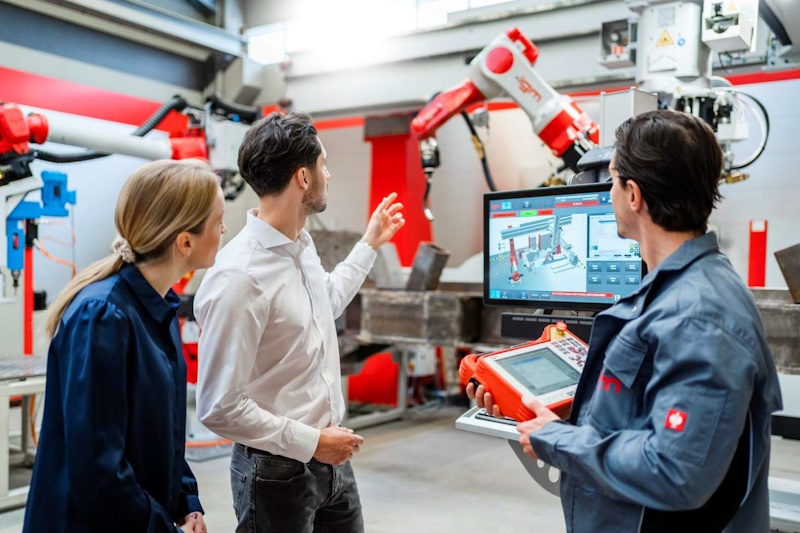
igm Robotersysteme AG builds welding robots for heavy components. The complex systems are operated intuitively in live 3D HMI.
The solution: From simulation to intelligent 3D HMI with twin
For around a year now, igm has been using digifai’s twin software to create an exact digital twin of its systems. According to Auer, the advantages are fundamental and manifest themselves in three core areas:
1. Error-free development and virtual commissioning
In the past, control software was developed in parallel with the construction of the machine and could only be tested in a rudimentary manner in advance. The holistic interaction of all components was tested directly at the customer’s site under time pressure — an approach that can lead to expensive service calls and production downtime.
With twin, this process has changed radically. Engineers now develop and test PLC programs on the virtual model long before the first metal part is manufactured.
- Collision detection: Potential collisions between machine components are detected early on in the simulation, allowing the plant design to be proactively improved.
- Parallel processes: Software development and testing run parallel to real-world mechanical engineering. Virtual commissioning decouples engineers from physical hardware and creates valuable time buffers.
- Accelerated testing: Processes that take hours in reality can be simulated virtually in minutes. This enables comprehensive test scenarios that would be unthinkable on the real machine.
2. Revolution in machine operation: The 3D HMI
After successful commissioning, the digital twin is not archived — it becomes the centerpiece of daily machine operation. As an interactive 3D HMI on the touchscreen, it offers invaluable added value.
“In the past, you had to leaf through 1,000 pages of documentation when a fault occurred. Today, you simply tap on the relevant component on the 3D model and all the relevant documents and diagnostic data are displayed immediately.”
Otto Auer – Head of Control Technology, igm Robotersysteme AG
In addition, the movements of the robots, which run shielded in the welding cell, can be followed live on screen. This not only increases safety, but also improves understanding of the process.
3. Efficiency throughout the entire life cycle
The advantages of twin do not end after commissioning.
- Retrofits and conversions: When a retrofit or adaptation to new products is pending, all changes are first tested risk-free on the digital twin. This ensures that the converted plant is immediately productive again — a decisive factor in the context of Industry 4.0.
- Training and education: Future operators can be trained on the animated model long before the actual system is installed. This allows operating concepts to be validated and optimized at an early stage.
- Sales and marketing: An animated 3D model is more convincing in sales than any 2D drawing. It creates a common understanding and prevents misunderstandings in the engineering process.
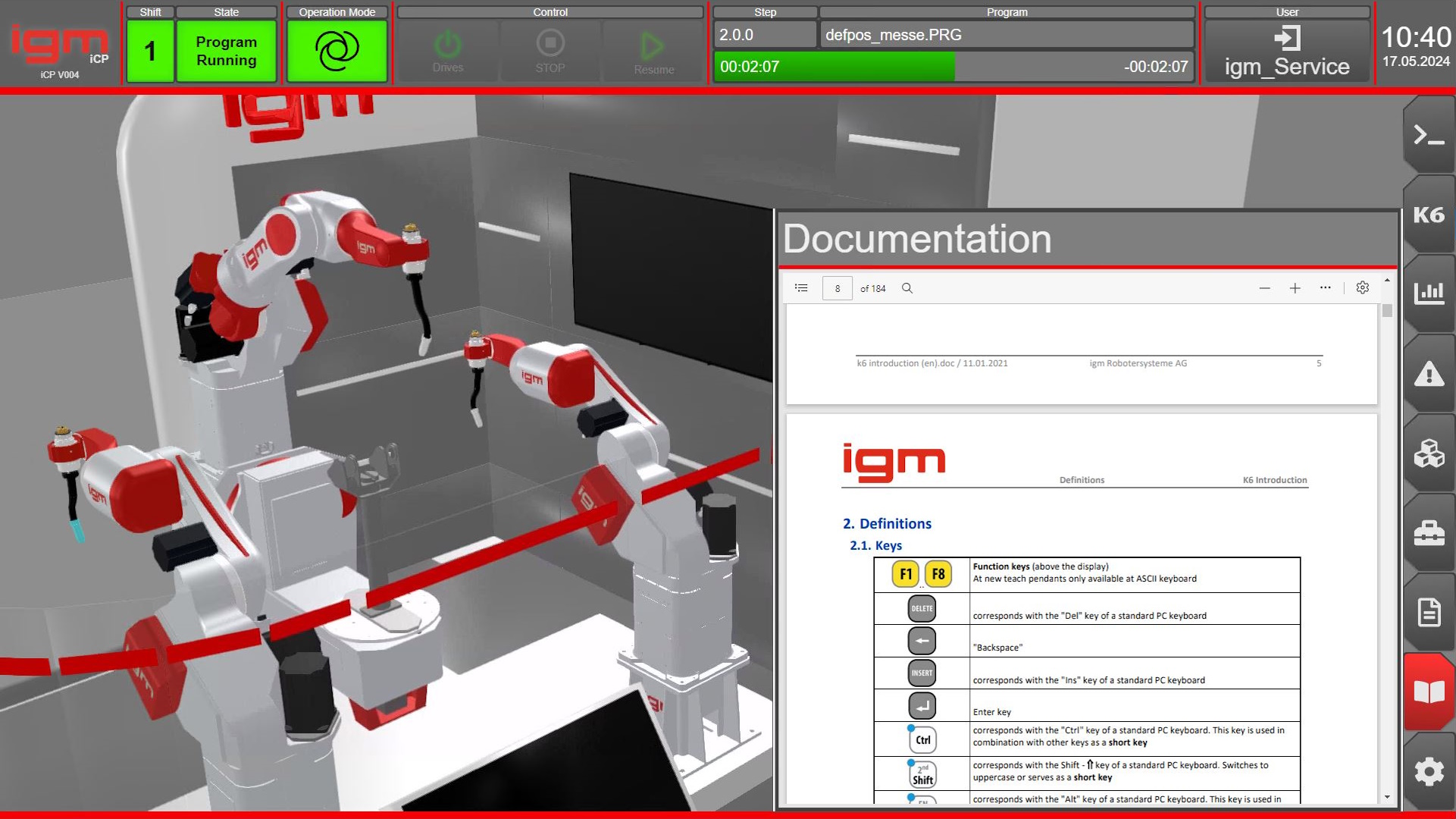
The intuitive 3D HMI is the central control point for the system. Fault messages are displayed directly in 3D, for example, and important documents such as maintenance instructions can be accessed directly by tapping on a 3D object.
The result: 40% time savings and maximum process reliability
The introduction of twin has led to measurable success at igm. Otto Auer summarizes:
“This type of commissioning saved us around 40% in time, which corresponds to around 160 working hours – a huge amount. You can bring work forward and validate the software while the system is still being built.”
Otto Auer – Head of Control Technology, igm Robotersysteme AG
Close cooperation with the software manufacturer was a key factor in this. “digifai responded perfectly to our specific problems. For example, it was essential for us that the welding arc be visualized in the 3D HMI. This flexibility convinced us.”
Conclusion: An investment that pays off
The decision to use twin is more than just the purchase of software. It is a strategic investment in efficiency, safety, and future viability. By shifting the time-consuming and cost-intensive phases of commissioning to the engineering stage, companies such as igm Robotersysteme gain a decisive competitive advantage. The digital twin is proving to be a powerful tool that is permanently changing mechanical engineering – from the initial idea to the end of the life cycle.
Are you ready to revolutionize your commissioning processes and minimize costly risks?
Discover the full potential of twin, the leading all-round simulation software, for your company. Contact us now to learn more about the digital twin and interactive 3D HMI.
// Contact
Curious?
Do you have a concrete project in mind or would you like advice on whether you can benefit from digifai? I look forward to your message.

Michael Eberle
Head of digifai
+43 5572 55580 803
michael.eberle@digifai.com